Futuro Fortissimo Archive
🎼 ff.103 Fire, Iron, Intelligence
OpenAI's new o1 model: a new era for humanity?
Published · Michele Merelli
- Does Artificial Intelligence think now?
- Analysing black holes in 5 minutes
- Are we living inside the film Her?
🍓 ff.103.1 Think before you speak
Substack ↗I know, we're tired of pairing “intelligence” with “artificial”. But OpenAI's new model, o1 (aka Project Strawberry), opens up a futuro fortissimo. I couldn't let it pass.
GPT vs o1? The default on chatgpt.com, GPT-4 is the gossip's model, the quick answer, the bar-room chat. It isn't ideal where more elaborate answers are needed.
So here's the fruit of knowledge: a strawberry, o1.
o1 thinks before it speaks.
Think before you speak and judge, try to think Think that you can decide Stay just a moment, one moment more With your head in your hands Fabrizio Moro, Pensa
Learning to Reason with LLMs details the differences from the past. The most important thing is in the chart below.
More parameters and data “during training” give better results. We knew that.
With o1, the breakthrough comes after “training”: by increasing the resources allocated to the answer, the model explores internal "reasoning trees" (chain of thought) more deeply. With better results.




🎓 ff.103.2 NASA, MENSA and IQ
Substack ↗The new model's abilities are astonishing, especially in fields with a single right answer (science, maths, coding).
For example, in 5 minutes it built a black-hole filter that had cost the NASA researcher in this video 10 months of work. His initial reaction is worth the ticket alone.
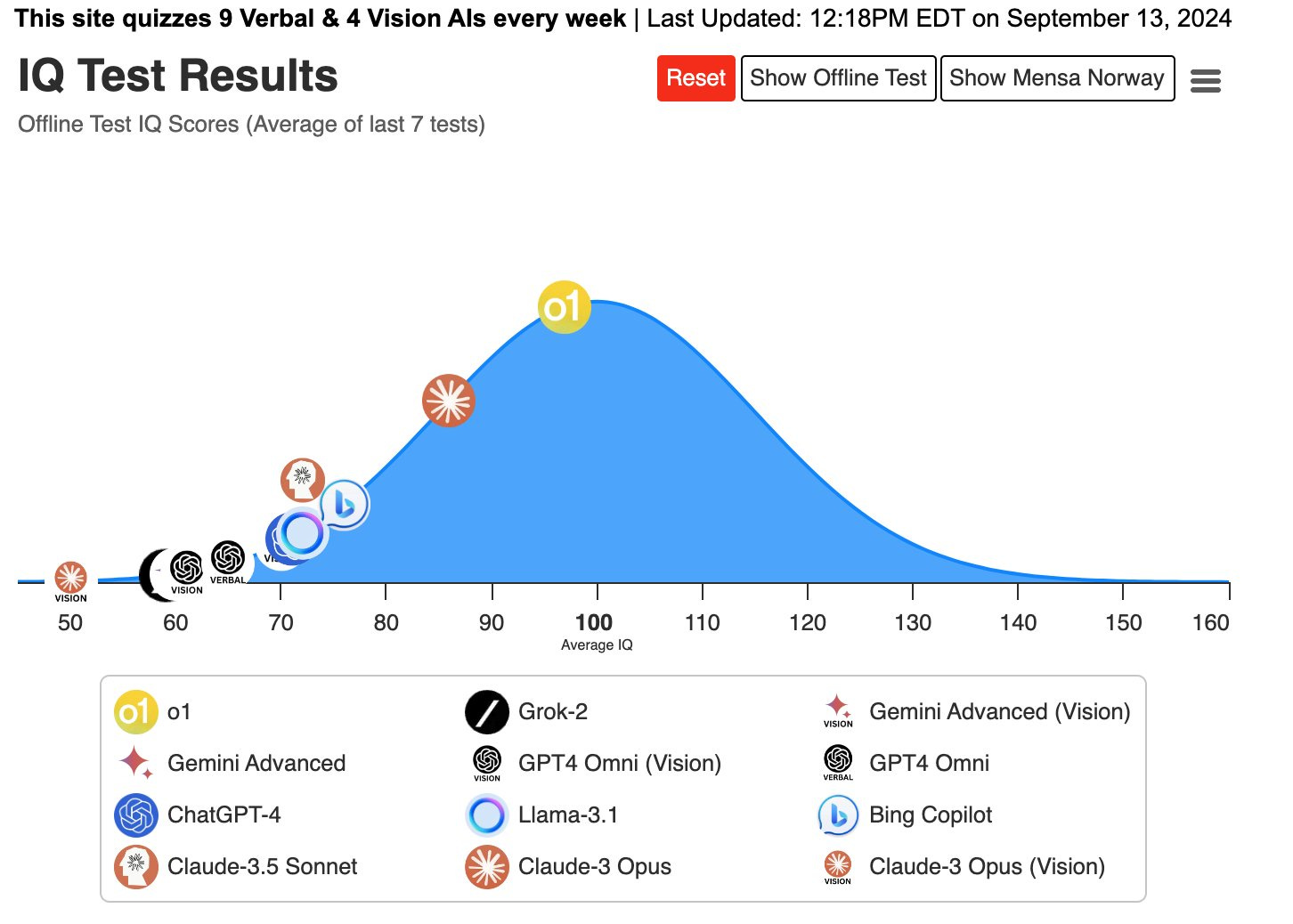
@Maximlott gave o1 the MENSA test, using non-public questions to minimise the chance it had memorised them.
The result? o1 has the IQ of an “average” person, around 100. More than the number itself, what's striking is the IQ jump from the past (GPT-4 has an IQ of 60).
🆕 ff.103.3 The new Era of Intelligence
Substack ↗OpenAI applied deep learning (the same as AlphaGo, ♟️ ff.18.4 Artistic chess: the king of chess) to text generation. A new paradigm, so much so that OpenAI's CEO Sam Altman talks of an Age of Intelligence.
How did we get to the doorstep of the next leap in prosperity? In three words: deep learning worked. In 15 words: deep learning worked, got predictably better with scale, and we dedicated increasing resources to it. Sam Altman, The Intelligence Age
With the Ages of Fire and Iron we mastered energy and matter. Today we can combine them to generate knowledge.
Here is one narrow way to look at human history: after thousands of years of compounding scientific discovery and technological progress, we have figured out how to melt sand, add some impurities, arrange it with astonishing precision at extraordinarily tiny scale into computer chips, run energy through it, and end up with systems capable of creating increasingly capable artificial intelligence. Sam Altman, The Intelligence Age

👩 ff.103.4 Turing and Her
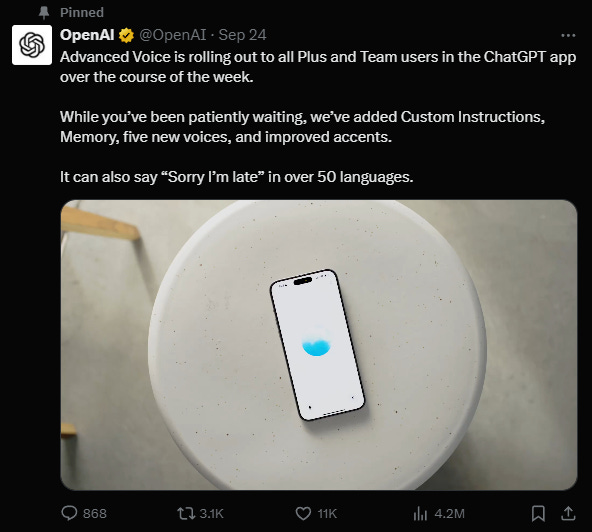
Substack ↗Alongside o1, OpenAI released an “advanced voice mode” for GPT-4:
It interacts more naturally, stopping if the user comments or picks the conversation back up. It can imitate voices and accents (and cats!). It adapts its tone to convey emotions / psychophysical states
These improvements make talking to GPT natural, “human”.
Hooked on news that expires in a day, we skipped right over the fact that the Turing Test has probably been passed.
Are we in a film? Set in the San Francisco of 2025 (!), our reality looks more and more like the film Her (2013).
2 examples of GPT-4 Advanced Voice:
@LinusEkenstam asked GPT to recite tongue twisters without breathing. GPT replied that - like every living being - it needs to breathe, then stressed the importance of pauses for separating words. Philosophical.
And then: real-time translation, sports-commentator emphasis, the sound of 10 cats in a room, and jokes from a melancholy Turkish comedian:
🎶 fortissimo notes archive
☕ virtual coffee
❤️ a little heart below?
👋 See you soon, from micmer
© futuro fortissimo | michele merelli