Futuro Fortissimo Archive
🎼 ff.29 Long live mum!
Population decline, surrogate wombs and Grimes
Published · Michele Merelli
- Is humanity doomed to disappear, now that we're no longer having children? What trends for 2100?
- How much should mothers be paid for being mums?
- Musk, his ex Grimes and their views on it.
👶 ff.29.1 We're not having kids any more
Substack ↗Apparently, even though in some parts of the world the population is booming (remember 🎼 ff.13 Populations and pollutions?), Elon Musk is extremely worried because people aren't having children.
No kids, no future (on Mars). To populate Mars, you first need a stable demographic base on Earth. With the right share of young people able to “support the economy”.
Elon Musk@elonmuskWe should be much more worried about population collapse5:02 PM ∙ Jan 18, 2022193,003Likes20,155Retweets
The global average fertility rate per woman has fallen from 4.5 children (!) to about 2.4 over the last 60 years.
And the projections for 2100 aren't rosy, with China and India below a billion inhabitants and countries like Japan halved. Don't worry, because in Nigeria they'll “keep at it”.
Why is this happening? What can we do to reverse the trend? A Washington Post journalist, the singer Grimes and a book on the next 500 years give us some ideas.


👩💻 ff.29.2 Being a mum is a job!
Substack ↗A crucial issue around motherhood is its cost. In an ever more individualistic, capitalist, profit-driven world, even motherhood gets quantified.
1700 feeds. Alyssa Rosenberg, a Washington Post journalist, tracked every breastfeeding session she did in her first 6 months of motherhood. They're the little dashes below.
She then calculated the wage she should receive if every feed and caregiving stint were paid at the US minimum wage, including living costs (basically, the milk produced). Considering the average US wage and roughly 2 and a half hours a day, the total cost over 6 months comes to 13,000 dollars.
Vitalik Buterin, father (lol) of Ethereum, also weighed in on the wage asymmetries between men and women that follow childbirth. If the 13,000 dollars were counted, they'd probably be smaller.
vitalik. eth@VitalikButerin@DeepCipher@shl@elonmuskDisparities in economic success between men and women are far larger once marriage+children enter the picture. Synthetic wombs would remove the high burden of pregnancy, significantly reducing the inequality. vox. comA stunning chart shows the true cause of the gender wage gapThe gender wage gap is really a child care penalty5:27 PM ∙ Jan 18, 20224,059Likes585Retweets


💰 ff.29.3 Elon Musk's girlfriend proposes paying mums
Substack ↗Elon Musk's ex-girlfriend (mother of the infamous human being X Æ A-Xii, a name as unique as it is rare) also spoke out on the issue. She proposed a MaternityDAO, i.e. a Decentralized Autonomous Organization to give credit to mums all over the world.
In a few points, here's what she proposes:
Capitalism doesn't give motherhood its fair value: a well-raised, educated, healthy, sporty child will one day be a priceless source of progress for society. Although “pro-life” welfare measures exist (baby bonuses, to be clear), they often do a poor job of capturing the dynamics of a child's growth that benefit society. Having children is one thing; raising them as model citizens is another. A MaternityDAO could address these problems with quantitative measurement tools. Based on how “well you raise your child” and their positive impact on society, the mother would receive proportional recognition and rewards.
Obviously the line between utopia and dystopia is thin and fragile. Measuring a child's positive impact or ranking their growth can easily veer into undemocratic systems like the “social credit” ranking we find in China. But it's important to think about how to improve welfare with the new possibilities technology gives us.
🧫 ff.29.4 Unconventional motherhood: wombs “in glass”
Substack ↗In a sense, though, the market has already started “compensating” motherhood: in surrogacy cases (I hate the Italian term “rented womb”, to be honest), the surrogate mother providing the service is handsomely paid by a biologically infertile mother.
Almost 1000 mothers dead. Even where a mother can handle a pregnancy, despite medical progress, still today around 1000 mothers can die in a single year in the United States. What's more, although the champions of pain see labour pains as essential and “natural” for such an important moment, I'm sure some women would gladly do without the physical limitations, risks and pain of pregnancy.
Speaking of dystopia, The Handmaid's Tale imagines a future where a male-chauvinist government subjugates the few fertile women (the Handmaids) to “bend the female body and its reproductive functions to its own ends”.
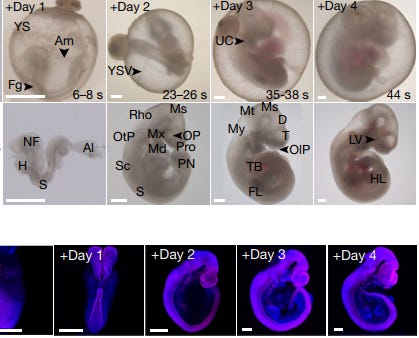
Rented wombs? Yes, but non-human ones. A 2021 study in Nature showed it's possible to grow physiologically stable mouse foetuses in extra-uterine cultures (rotating glass vials). A solution that may make people wrinkle their noses at first, but that could bring considerable social, demographic, psychological and economic benefits.
Maybe one day we'll manage to see reproduction in a demystified way, free from all the religious/magical/ritual flavour we carry around today. That is, as a mere biological process, like eating, sleeping, having sex.
Oh, in case this analysis wasn't enough for you, there's more here.
👋 And that's all for this fortissimo week! 🔜 In the next ff we'll talk about DALL-E (a mix of Dalí and WALL-E)! See you soon, Michele
Want to support this project? Subscribe to the newsletter and share it with a friend on WhatsApp
👇🔥Subscribe
Or buy me a coffee 😏
☕
And remember to leave a little heart below.
❤️