
Futuro Fortissimo Archive
🎼 ff.44 Such anxiety! (pt. 1)
Why thinking less about the future is sometimes good for you
Published · Michele Merelli
- A monthly overview of the topics you care about most, from the most varied sources, on your favourite social networks.
- A different topic every month, so you always have something new to discuss with friends and family!
Themes📱 Attention, screens and habits🎨 Culture, books and art
☑️ ff.44.1 The modern fallacy of time in boxes
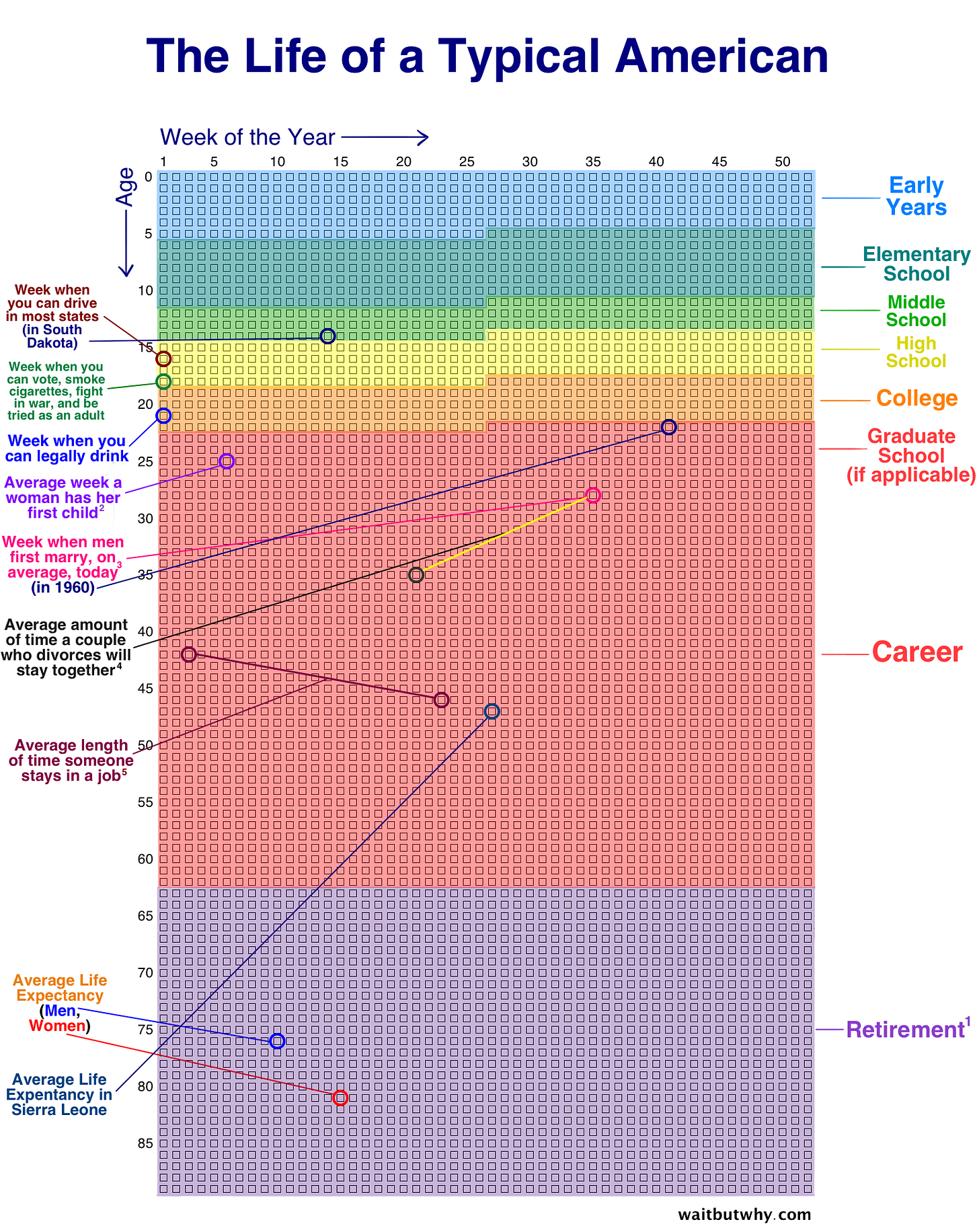
Substack ↗4000 Weeks opens with a historical excursus. In the Middle Ages, when time couldn't be measured, all human activities were dictated by natural rhythms. There was no point trying to optimise the apple harvest (maybe with KPIs or market analysis): you had to wait for them to ripen. Same with milking cows.
Today, instead, time is a continuous flow, made of minutes, hours, days. Time today is a conveyor belt that never stops, with boxes to fill every hour that otherwise go unused. Wasted. Tim Urban, fittingly, visualises the 4000 weeks like this:
And so come the deadlines, the 25-5 Pomodoro methods, the productivity guides (which exploded after the pandemic, didn't they?).
♾️ ff.44.2 The infinitude out there
Substack ↗Even if these boxes existed, how could we ever fill finite boxes with the infinite objects (and experiences) around us?
The digital world doesn't help:
The alternative way to spend your time, where to go on holiday, which film to watch is ready in the next Instagram story, the next online article, the next TripAdvisor review. Alternatives are served up in 15-second TikToks and infinite feeds, where even if we try to fill a box with something, to focus on one experience, a few seconds later we're on a different app, with a different thought, trying to squeeze in something else.
Burkeman argues that the anxiety of choosing, of defining a box, is philosophically inseparable from Heidegger's concepts of “being” and “existence”.
To overcome the anxiety of our present, we need to accept our own finitude and the finitude of the real world, which, unlike virtual worlds and metaverses, is the only one that can truly materialise and “be”.
🏠 ff.44.3 Settling down steadies you
Substack ↗Decided? Not by chance, in Italian decidere (to decide) shares its root with uccidere (to kill) and recidere (to cut off). Cutting. Removing opportunities.
We don't know how to do it: every kind of commitment, of tie, scares us. It means ruling out other opportunities.
Not that this message is new, mind you. Kierkegaard (Heidegger's close intellectual relative) was already talking about it in 1843 (which is as far from us as 2201). Do you think anyone will remember this newsletter in 2201?
La sua libertà di scelta non rappresenta la sua grandezza, ma il suo permanente dramma. Infatti egli si trova sempre difronte all'alternativa di una "possibilità che sí" e di una "possibilità che no" senza possedere alcun criterio di scelta. E brancola nel buio, in una posizione instabile, nella permanente indecisione, senza riuscire ad orientare la propria vita, intenzionalmente, in un senso o nell'altro. Søren Kierkegaard,Aut-aut
That said, it must be said that Kierkegaard, a never-sated womaniser, didn't have Tinder. Otherwise who knows how many more books he'd have written.
🖼️ ff.44.4 Wasting 3 hours in front of a painting
Substack ↗One of the book's messages is that the constant search for new stimuli and time optimisation is a way to escape the anxiety of standing still. It's a way not to think about our essence, our finitude, our mortality.
So the author reports an assignment that Jennifer Roberts, an art history professor at Harvard, gives her students every year: stare at a painting for three hours.
Certeforme d'arte impongono vincoli temporali al loro pubblico in modo piuttosto ovvio: quando guardi, ad esempio, un'esibizione dal vivo deLe nozze di Figaroo una proiezione diLawrence d'Arabia, non hai altra scelta che dedicare all'opera il tuo tempo. Oliver Burkeman,Come fare per avere più tempo? Time management per comuni mortali
Personal note. I don't know about you, but more and more often I find myself not finishing a film. Leaving it halfway. “I'll finish it later”, I tell myself, gripped by the anxiety of doing something else.
4️⃣ ff.44.5 4 ways to find a cure
Substack ↗I like to suggest solutions after defining a problem. The author suggests:
Atelic activities (like walking, cultivating hobbies, activities with no ultimate goal where you can't “fail”); Setting reasonable, finite goals (I work on 🎼ff for half an hour, then I've done my bit for today!); Keeping a done-list (to remind us how much we've already achieved); Avoiding forcing carpe diem: focusing too much on living in the moment is itself a fallacy, like trying to fall asleep by thinking hard about falling asleep.
👋 And that's all for this fortissimo week! 🔜 In the next ff we'll talk about 2022 and 2023!
See you soon, Michele
Want to support this project? Subscribe to the newsletter and share it with a friend on WhatsApp
👇🔥Subscribe
Or buy me a coffee 😏
☕
And remember to leave a little heart below.
❤️