
Futuro Fortissimo Archive
🎼 ff.105 Electricity and life
Galvani, Frankenstein and Poor Things: we are electric
Published · Michele Merelli
- The effects of electricity on a growing foetus
- DNA isn't everything in human development?
- Human neurons in tomorrow's PCs?
🤴ff.105.1 Turning a frog into Prince Charming?
Substack ↗Once upon a Volta, Galvani. In the late 1700s, Italy was at the centre of the electrical world. People wondered whether electricity was natural or belonged only to man-made materials, like metals.
Galvani backed the natural thesis: he threw himself into experiments with so many frogs that, in some areas, they almost disappeared.
Volta instead focused on metals, going on to invent the first battery and temporarily eclipsing Galvani's discoveries.
Anal electricity? A 60,000-franc prize for creating an "animal battery" drove scientists mad: Humboldt went as far as self-experimentation, inserting wires into his own rectum.
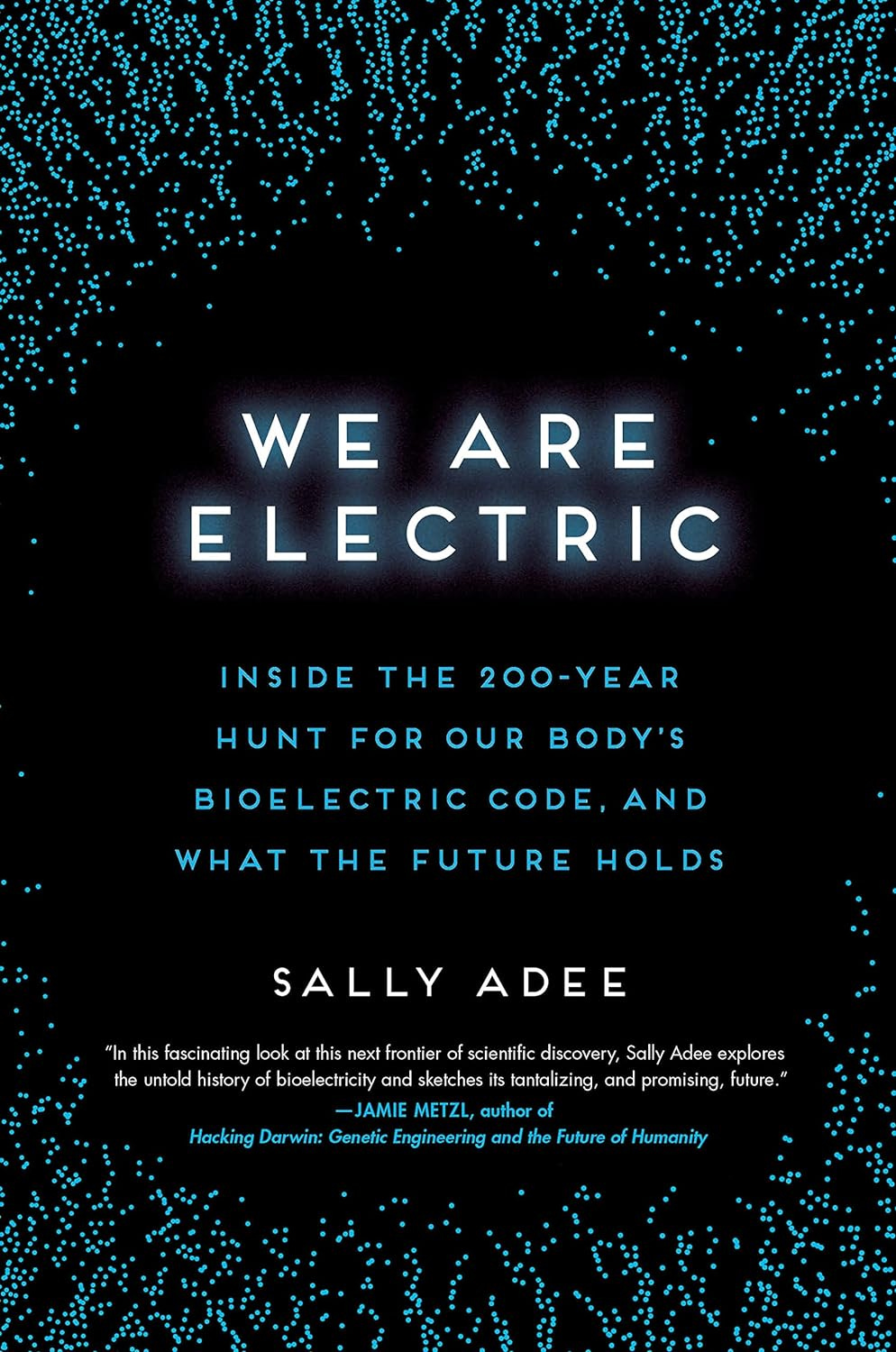
That's the historical digression that opens We Are Electric by Sally Adee, science writer for New Scientist and The Economist. The perfect book for today's newsletter, between brains, electricity and experiments worthy of Frankenstein.
🧠ff.105.2 Frogs, brains and ion channels
Substack ↗With the discovery of neurotransmitters (molecules, so chemistry), the role of electricity in the body (and brain) seemed eclipsed for good.
Electrifying comebacks. It took Hodgkin and Huxley (1952, Nobel 1963) to measure the action potential in neurons (using a giant squid) and Neher and Sakmann (Nobel 1991) to isolate ion channels.
Today the influence of electricity on biological processes is expanding even further. Let's see how.
⚡ff.105.3 The electrome
Substack ↗Michael Levin is bypassing DNA to reprogram life through electricity.
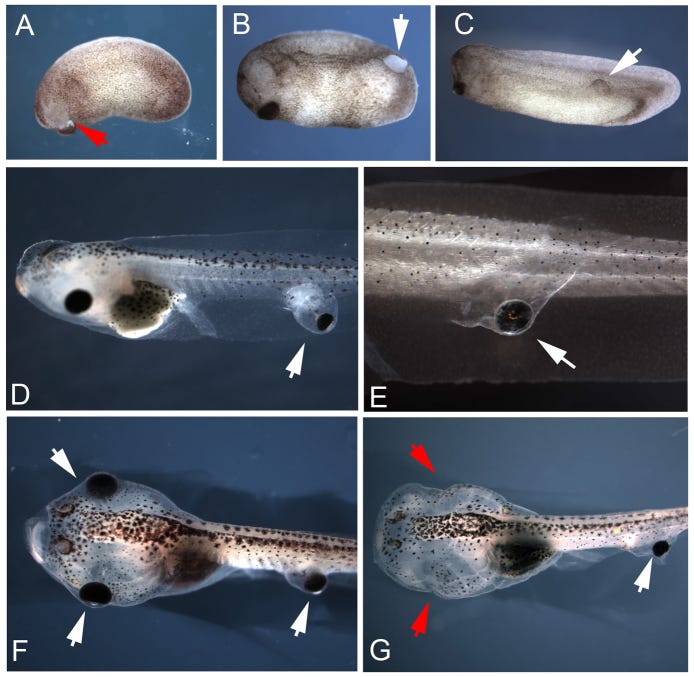
For example, he grew a fully working eye on a frog's backside (yes, frogs and backsides are clearly popular).
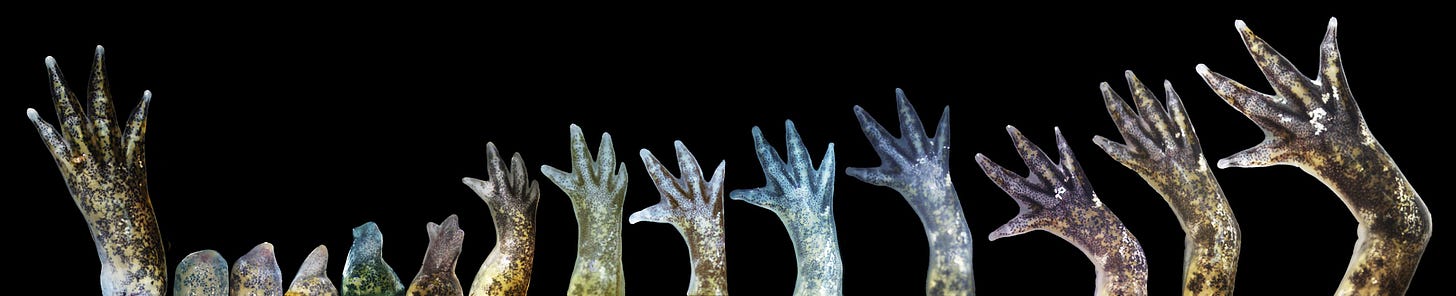
By influencing sodium-potassium channels, electric fields can localise/extend a tumour. Or regenerate the leg of… wait for it… a frog.
And more. With AI he designs “artificial legs” optimised for certain movements. Then, with electric fields, he controls their growth: the birth of xenobots.
If you want to dig deeper, a summary here.

🏓ff.105.4 Neurons that play Pong
Substack ↗This tangle of computers, AI and biological substrates is fascinating (we talked about it in the early days of futuro fortissimo, 🦠 ff.4.5 Computational microbes?).
I was blown away when I discovered FinalSpark, a Swiss start-up using lab-grown neurons to build biological chips.
The algorithms behind ChatGPT adjust the "weights" of the nerve connections of a “simulated” brain (traditional machine learning, on silicon chips).
FinalSpark's chips, instead, are neurons that grow shaped by the electrical action of learning, guided also by dopamine and by cellular energy optimisation. Electric. Biological.
In 5 minutes they teach a neural network to play Pong, reaching an energy efficiency 10,000 times better than what we find in a computer.
Yes, I know what you're thinking. Poor creatures!
❤️ a little heart below?
☕ or buy me a virtual coffee
🎶 fortissimo notes archive
👋 See you soon, from micmer
© futuro fortissimo | michele merelli


