Futuro Fortissimo Archive
🎼 ff.21 The magic of salad delivered to your door
Why we should marvel, especially today, at the complexity of the world around us.
Published · Michele Merelli
- What's the minimum number of human beings needed to build a Bic pen?
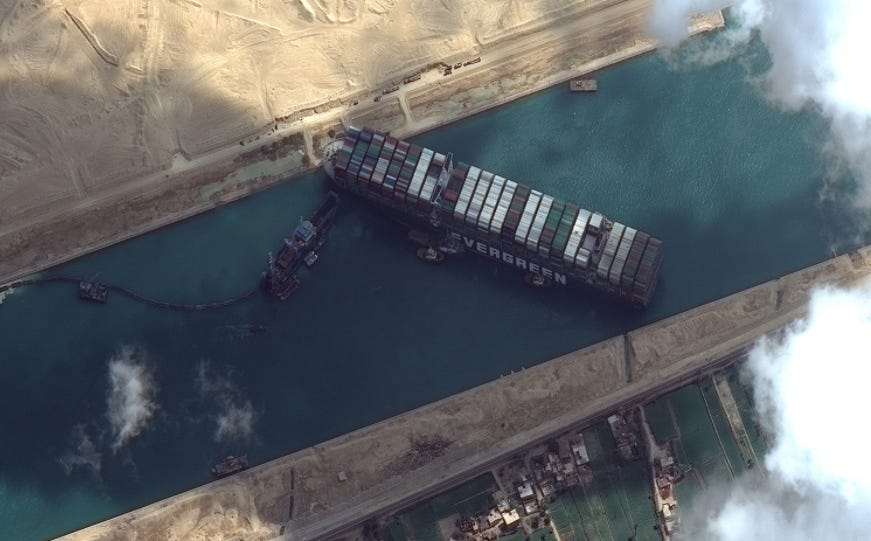
- Did globalisation end with the Ever Given?
- How can we protect the fragile complexity of the world around us (after the invasion of Ukraine)?
Themes🏛 Geopolitics, economy and society📱 Attention, screens and habits
💰 ff.21.1 The magic of home-delivered salad and the Bic pen
Substack ↗Tim Urban is a lovely guy. He runs the site Wait But Why (a container of deep concepts comically delivered with MS Paint graphics) and was a guest on the Lex Fridman Podcast. At the start of the chat, they talk about the complexity of the world around us.
Did Bic leave us its pens? No human knows how to build a ballpoint pen, because no human knows the techniques for:
extracting the necessary materials, forging them, developing the chemistry of plastic and ink, design and research
PS: To extract you need a shovel, which has to be built, and for plastic chemistry you need glass, fire. In short, an endless series of other steps… (Elon Musk estimates it takes at least 1 million people to sustain the complexity of the society around us, at least to create a stable civilisation on Mars)
But one artist managed to build a toaster.
Light bulbs and salad. Around the 20th minute of the conversation, Tim also asks us to reflect on the complexity of the system that makes the light appear when we flip the switch at home. It's dizzying. Just as dizzying as ordering a salad for lunch on Deliveroo and hearing the doorbell 10 minutes later, complete with Greek dressing and avocado grown - perhaps - on the other side of the world.
This technological progress is born from the interplay of technology, society and education in an interconnected world (culturally and logistically) like the one we live in. Or used to live in?

🚢 ff.21.2 The end of an era?
Substack ↗And yet, since 2008 there seem to be some signs of crisis in this idyllic world. Or not? Let's take a closer look.
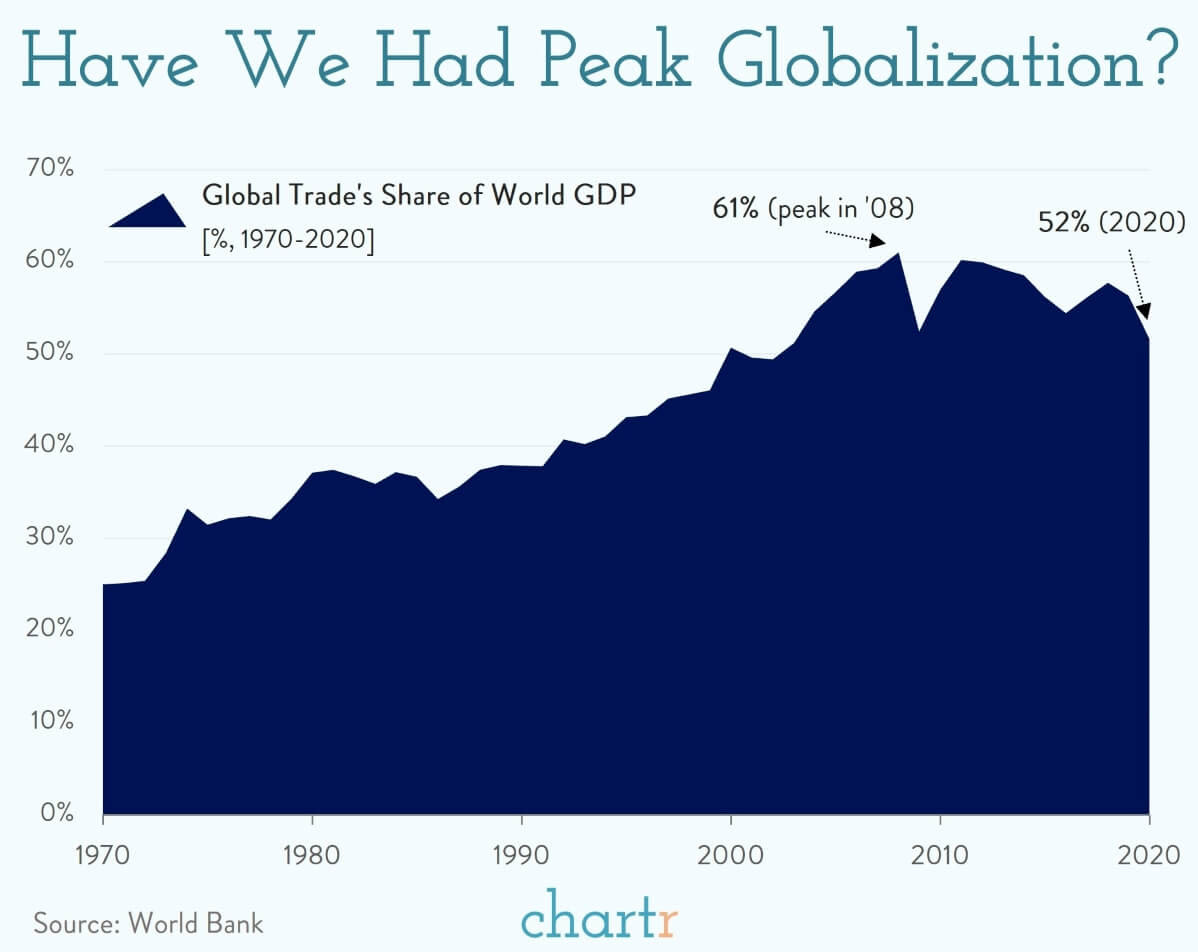
On the one hand, the share of global GDP tied to trade is declining. The peak was in 2008. For 10 years now this number has stopped growing, falling back to 2000 levels in 2020.
But, but, but. Maybe this number isn't the best way to quantify globalisation. Other trends have reduced "physical" trade, even though connections haven't decreased at all.
📡 ff.21.3 Or the start of another?
Substack ↗Some features of the era that began after the financial crisis, characterised by:
Digitalisation, social media, technological developments in communication; the growth of the tertiary sector, services; the competitiveness of robots at work, which narrows the gap between labour costs in more developed countries and those in Asia; the lower impact of resources on GDP (dematerialisation); as with automation, 3D printing could lead to further localisation of production where the material is extracted.
Intangibles. If you've spent more on an NFT of sneakers in League of Legends than at the Nike store in your country, you're not alone. Much of the value of the brands and products around us is intangible (tied to the company's know-how, marketing, training, brand value…).
Investment in physical versus intangible assets has flipped over the last 20 years:
If you want to dig deeper into globalisation trends, there's of course a McKinsey study.

🙊 ff.21.4 More interesting food for thought
Substack ↗In this chat with General Richard Barrons (formerly Commander of the UK's Joint Forces Command), Azeem Azhar talked about the future of war back in 2019 (!).
Today, some of the predictions that come up in this conversation are truly incredible. Even though the focus was also on other kinds of war, seeing the "boots on the ground with militias" kind as not very fruitful and almost anachronistic
War is increasingly fought through the influence of media, trade (see sanctions) and hacker attacks. War is increasingly non-human and remote: technically, you can do terrible damage with intercontinental missiles, drones and automated processes. As in 2014, with the intervention estimated at between 3 and 15 minutes. Nations, but above all multinationals, can wield considerable soft power, leveraging the prosperity they generate (and he was amazed that after the attack on Crimea Russian oligarchs could still go shopping in London and enjoy all the related comforts)
And then, back to the fragile complexity of the world around us:
Finding food on supermarket shelves is now seen as a right. No: we need to learn about the world's fragility. It isn't guaranteed, we have to do our part for its complexity. Prosperity also comes above all from the priorities of state investment (see the percentage of GDP spent on the military). Germany has already said it will go from 2% to 4% of GDP for defence… We have to fight to keep certain freedoms. Personal resilience, on social media too. 100 years ago, people were called to arms. Today, we're called to be morally prepared and educated!!!
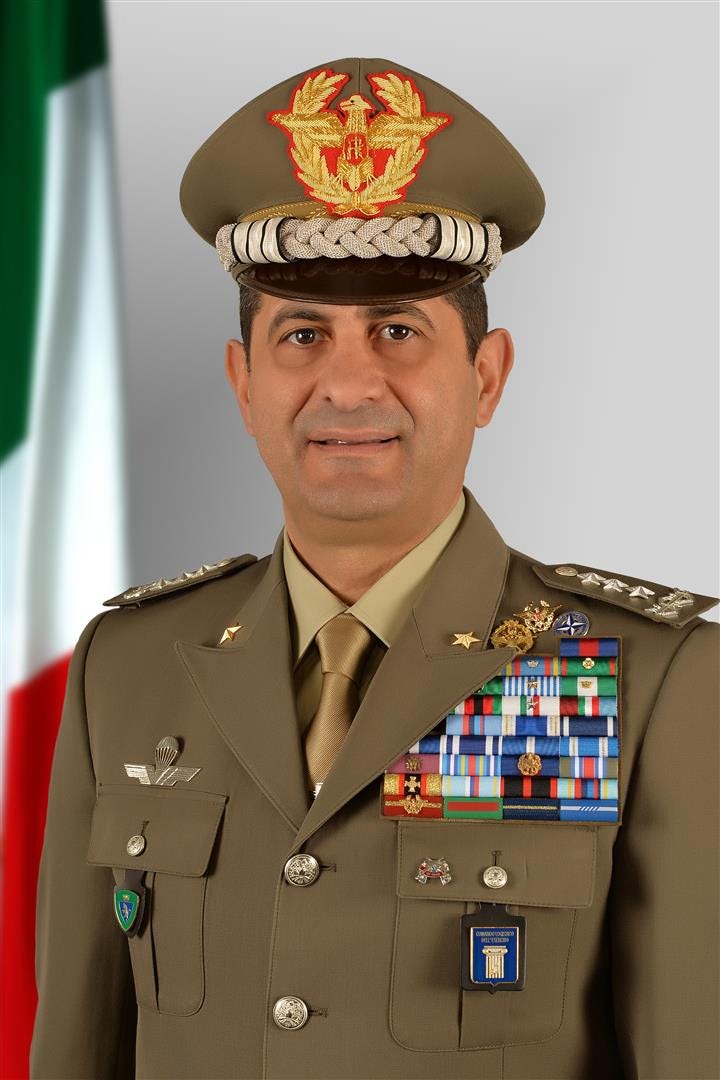
Tough? Don't worry: you don't need to collect all of General Figliuolo's medals.
🔜 In the next ff we'll talk about food and how much we eat!
Want to support this project? Subscribe to the newsletter and share it with a friend on WhatsApp
👇🔥Subscribe
Or buy me a coffee 😏
☕
And remember to leave a little heart below.
❤️