Futuro Fortissimo Archive
🎼 ff.22 Do we eat too much?
Circadian rhythms, kilocalories and mice that don't gain weight
Published · Michele Merelli
- Can we eat anything, if we do it within a 10-hour window?
- Do we eat more in company?
- Is there really a one-meal-a-day diet? Illustration by Rocío Egío, from It's Nice That
🕐 ff.22.1 A circadian diet?
Substack ↗I recently read a great book called The Circadian Code, about how important our circadian biological rhythm is for psycho-physical well-being.
A few key points:
Our body benefits from keeping circadian rhythms, because certain metabolic or repair processes are regulated by genes that switch on according to "the phase of the day we're in".
Our body struggles to figure out what phase of the day it's in, because:
Biologically it relies on exposure to bright, outdoor light, which is what "starts the day". Since we spend so much time inside buildings, this start-of-day exposure is missing or rare. Exposure to light / screens indoors, even late in the evening, delays "the end of the day" metabolically. Digestion stretching into the late evening delays or destabilises these daily rhythms.
In short, chaotic modern life has a significant impact on our circadian cycle.
Diet and digestion. Satchin Panda argues we should follow the TRE rule: Time Restricted Eating. In particular, to help activate circadian rhythms, he suggests limiting the digestion window to 10, at most 12 hours (for any food: even a beer can restart the whole costly digestive process).
Backing this up, a study in Nature Metabolism in which mice eating the same kcal per day lose more weight if they eat within a shorter time span.
Not just mice. Some criticism of the study focuses on the fact that it's about mice. But a recent study on humans showed something similar. If we limit food intake to a single meal instead of three, fat oxidation speeds up significantly:
0.7 kg of fat burned in 11 days, when "calorie" calculations said it should have been only 0.14 kg.
A likely explanation is fat use stimulated by low insulin levels during the day.
Also, spending 12-16 hours a day in the postprandial phase (basically a state of inflammation) may not be ideal for many other risk factors (diabetes and obesity are already known to be linked to it).
🪑 ff.22.2 Set another place (and a few kcal) at the table
Substack ↗Another thing we care about is socialising. In company, we can end up eating 25% up to 50% more than what we would eat if we were alone.
Let's not even talk about what happens at Christmas.

🥔 ff.22.3 Why eat unprocessed (and fibre-rich) food
Substack ↗A few dietary tips while we're at it, with the related studies. First, a simple rule of thumb to convert kcal into "weight":
3,500 kcal calorie deficit = 0.45 kg of fat burned
Self-combustion. When we eat something, we also spend energy processing the food. Well, if the food is unprocessed (made of more fibre, for example) we can use up to twice the energy to digest unprocessed foods.
An example: to digest two 800 kcal sandwiches you burn:
With white bread and processed cheese slices: 73 kcal. With wholemeal bread and less processed cheese: 137 kcal
Since obesity in the United States is linked to an increase of 300 kcal a day over the last 25 years, this "endogenous" and "free" increase in calorie burn could help.
🤰🏻 ff.22.4 The most filling foods
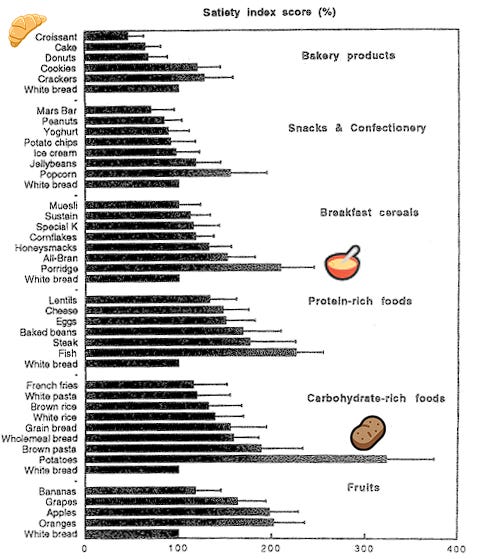
Substack ↗Another way to "keep hunger in check" is the satiety index. Not all foods, for the same kcal eaten, fill you up the same way. There's a nice study that tries to figure out which foods are the most filling, for the same calories (240 kcal per portion).
A positive correlation was found with water, fibre and protein, in decreasing order, as well as serving weight. A negative correlation with fat and palatability (how much you like it).
7 times more filling: potatoes top the chart, with an index of 332, versus 47 for the croissant. 76% of foods have a higher satiety index than white bread. Oranges and apples beat bananas, if you want to feel full.
🍹 ff.22.5 Shall we drink to that?
Substack ↗Alcohol is quite a beast too:
4 bottles of wine a month, over a year, is 27,000 kcal = 48 Big Macs (one a week), i.e. about +3.5 kg. 5 medium lagers a week, over a year, is 44,200 kcal = 221 doughnuts (one every other day), i.e. about 5.6 kg.
Should we all become breatharians at this point? This newsletter is depressing, I know. Cutting down on dinners with friends, desserts or other small pleasures, and quantifying every aspect of daily life, can be alienating. I don't think it's (psychologically) healthy to follow every single point. But we do need to be quantitatively aware. For better health and lower related economic costs (= more futuro fortissimo for everyone).
👋 And that's all for this fortissimo week! 🔜 In the next ff we'll talk about marriage! See you soon, Michele
P.S. If you're not blind with hunger by now.
Want to support this project? Subscribe to the newsletter and share it with a friend on WhatsApp
👇🔥Subscribe
Or buy me a coffee 😏
☕
And remember to leave a little heart below.
❤️