
Futuro Fortissimo Archive
🎼 ff.27 One million COVID deaths (US)
How newspapers and authors remember the huge hole COVID left behind
Published · Michele Merelli
- The New York Times' pixels
- The infinite scroll that piles up deaths
- The Washington Post's unfinished sentences
Themes🏃 Health, sport and body📱 Attention, screens and habits
⚈ ff.27.1 The New York Times' pixels
Substack ↗Over the last few years, The New York Times has been very attentive to the pandemic. I was struck by its report on Bergamo and the deaths of the first wave, with images taken directly from L'Eco di Bergamo and its countless pages “of the dead”.
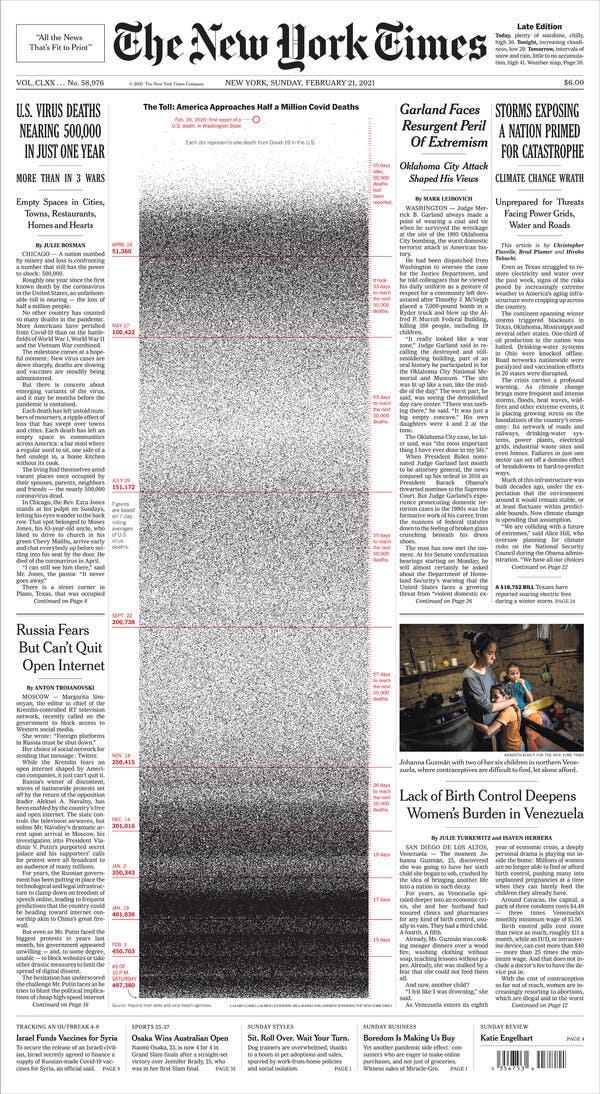
To remember the million dead, it tried to visualise them as pixels. Each dot, a human life. Used to being bombarded by billions upon billions of pixels every day, stopping on each black dot (a human life!) and giving it the time it deserves is incredibly hard. But that seems to be exactly what it's asking of us.
Here's the cover for the 500,000 dead. Already with the pixel theme, laid out vertically by day. Showing the progression of the pandemic.
Here instead is the age breakdown of the million dead. 650 thousand over 65.
And here are the waves of pixels. Half of the deaths came after vaccines were created (remember the not-so-high vaccination rate in the United States: 61% fully vaccinated, dropping to 31% for the third dose).
The page is interactive and, as you scroll, the pixels build a map of the geographic distribution of deaths.



🖱️ ff.27.2 Scrolling and deaths
Substack ↗Axios created another beautiful visualisation to put the victims and numbers of the pandemic in context: as you scroll this page, the dead pile up, as shown in the chart in the corner.
In January 2021 the death toll reached that of World War II (for the United States).
In September 2021, that of the 1918 pandemic (675 thousand). The US population has tripled since 1918, so 1.6M COVID deaths would mean a similar mortality rate. At 1M deaths today, we're not far off.


💬 ff.27.3 The Washington Post's unfinished sentences
Substack ↗The Washington Post, on the other hand, presented a project with a series of unfinished sentences. It doesn't aim to show every detail of the problem, but asks us to stop and read a few stories. It's frustrating. Because the opening page looks like this:
As you start reading, the sentence is cut off halfway. We don't know how it ends. Interruptions are perhaps one of the things we find hardest to handle mentally. Our brain is a prediction machine, always trying to anticipate what will happen.
Only by hovering the mouse over the sentence do we see how it would have been completed, had the person in question not died. Had the sentence of their life not been colonised by a virus that spread to every corner of the planet.
This Futuro Fortissimo ends here. With few articles. No futurism. Just the request to stop for a moment, to remember what was the darkest moment of the 21st century. And what other problems could arise in a similar way if we don't stop exponential curves in time.
P.S. We'll also talk about how COVID-19 spurred research and progress in medicine, but now is not the time.
👋 And that's all for this fortissimo week! 🔜 In the next ff we'll talk about how Google takes care of us! See you soon, Michele
Want to support this project? Subscribe to the newsletter and share it with a friend on WhatsApp
👇🔥Subscribe
Or buy me a coffee 😏
☕
And remember to leave a little heart below.
❤️

