Futuro Fortissimo Archive
🎼 ff.17 Sport (and the people who poop it)
Data from Strava and the toilet, to reach the next world record
Published · Michele Merelli
- Can urine and faeces tell us whether we'll break the world record?
- Are we a species of walkers?
- Do we train more when we see our friends' activities on Strava?
Themes🏃 Health, sport and body📱 Attention, screens and habits
🇳🇴 ff.17.1 Norway is obsessive
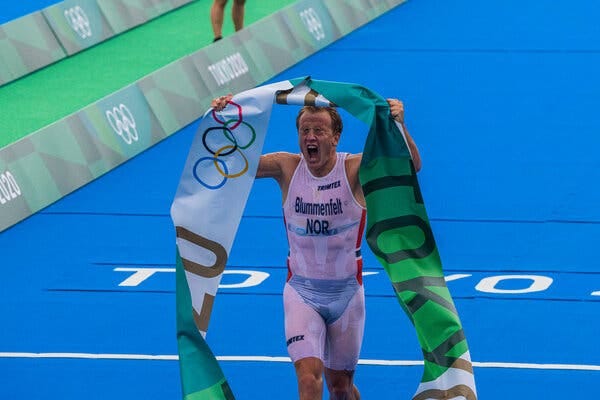
Substack ↗Allow me to introduce a monster: Kristian Blummenfelt. 27 years old, Norwegian, Olympic triathlon champion.
Just a few months after Beijing, he did an Ironman (roughly the distance of 4x Olympic triathlons) in 7 hours and 21 minutes. He smashed the previous record, in totally unfavourable conditions: it was raining, it was windy and, needless to say, he stopped for a bathroom break during the marathon, which he still finished in 2 hours and 35 minutes.
The New York Times devoted a detailed article to his training. Before we look at it together, let me introduce another person: the engineer Olav Aleksander Bu.
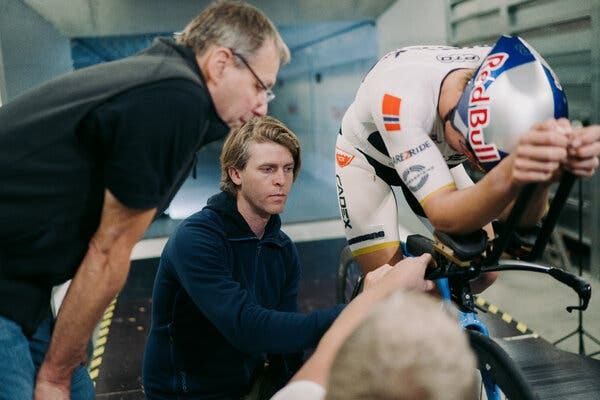
Sports engineering. Having joined the Norwegian Olympic team at the 2016 Games, right there in Rio he realised that, beyond aerodynamics and high-performance materials, sports know-how was stagnating.
From this realisation, he began diligent research, obsessively correlating physiological responses with his athletes' performance. A few examples?
He found that Blummenfelt was so mentally strong that he burned through his glycogen reserves too quickly. So, by measuring blood lactate, he found the right pace for the athlete to train longer and more consistently. He worked with a company able to measure heat dissipation, to understand how much energy was being "wasted" on thermoregulation. He had him drink a 2,000 dollar bottle with oxygen isotopes, to work out, from his urine, how efficiently he used oxygen. He studied his faeces (no, not during the marathon) to understand his carbohydrate metabolism.

🏃 ff.17.2 Strava's 2021 report
Substack ↗Every year, like Spotify Wrapped and similar recaps, Strava also does a roundup of uploaded activities. You'll find it here.
Some significant data:
It wasn't just the start of the pandemic: 2021 also saw strong growth in the number of activities, 38% more than in 2020. In short, we kept training.
Those who started running in 2020 improved across all distances in 2021
Walks were the fastest-growing activity compared to 2020 (3x), maybe also because of boomers who seem to log even their trip to buy bread (just kidding).


🕸️ ff.17.3 Positive social networks?
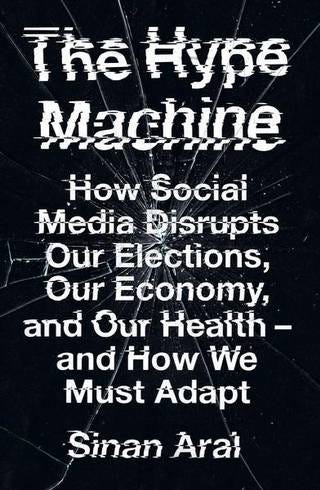
Substack ↗Since we're talking about data and sport, I was reminded of a wonderful book by Sinan Aral, MIT professor of Management, Marketing, IT and Data Science.
In his analysis of social networks, which I hope to come back to in the future (fortissimo!), he also dwells on Strava, which wears the crown of social networks in sport.
As early as 2018 the Strava team noticed that group bike rides are 50% longer. Runs 20% longer, if you have someone alongside, even if not all types of runners prefer running with other people.
Sinan set out to understand more about this social effect: can we be influenced, even from a distance, by our friends' workouts?
Cause or effect? Studies like this are tricky. It's hard to find a baseline, a "control" against the hypotheses, because every social aspect can be cause and effect at the same time. Let me explain. I might run more because I see others running, or I might see more people running simply because my friends are more likely to run (because I've somehow "selected" them).
Weather-sensitive from afar. You need a random factor that alters the baseline. The book reports a study helped by the weather, a random disturbance. Starting from the activities of a runner in Arizona (where it's always sunny, so in theory the frequency of exercise should be constant), the study found that he ran less on rainy days in the Big Apple, if he had a New Yorker as a friend on Strava.
Other observations from this weather-assisted study run by Aral:
Seeing a friend run 1km more on the app pushes us to do at least 750 metres more than our usual. Seeing a friend run 10 minutes more than our standard pushes us to run 3 minutes more on average.
Ok, I'm off for a run now. Even if it's raining.
👋 And that's all for this fortissimo week! 🔜 In the next ff we'll talk about artistic Artificial Intelligence! See you soon, Michele
Want to support this project? Subscribe to the newsletter and share it with a friend on WhatsApp
👇🔥Subscribe
Or buy me a coffee 😏
☕
And remember to leave a little heart below.
❤️