Futuro Fortissimo Archive
🎼 ff.41 I'm speechless
ChatGPT can play briscola and gives me the recipe for Bergamo-style casoncelli
Published · Michele Merelli
- A monthly overview of the topics you care about most, from the most varied sources, on your favourite social networks.
- A different topic every month, so you always have something new to discuss with friends and family!
Themes🤖 AI, agents and models
🍝 ff.41.1 It's all in the filling
Substack ↗Write the recipe for casoncelli alla bergamasca
Casoncelli alla bergamasca are a typical dish of Bergamo cuisine. Here are the ingredients and the method to prepare them:
Ingredients:
500 g 00 flour; 250 g ricotta; 100 g butter; 100 g smoked pancetta; 100 g grated parmesan; 1 egg; 1 onion; 1 celery stalk; 1 carrot; 1 garlic clove; 1/2 glass white wine; Salt and pepper to taste.
Method:
In a saucepan, sauté the finely chopped onion, celery, carrot and garlic with a little butter. Add the diced smoked pancetta and brown for a few minutes. Deglaze with the white wine and let it evaporate. In a bowl, mix the ricotta with the grated parmesan, the egg, salt and pepper. Roll the pasta out very thin and, using a pastry cutter or a glass, cut out discs. Place a little filling in the centre of each disc and fold the casoncelli into half-moons, sealing the edges well with your fingers or a fork. Cook the casoncelli in plenty of boiling salted water for 3-4 minutes, then drain and dress them with the pancetta sauce prepared earlier. Serve the casoncelli piping hot, topped with a sprinkle of grated parmesan. Enjoy your meal!
🐆 ff.41.2 Leopardi explained by AI
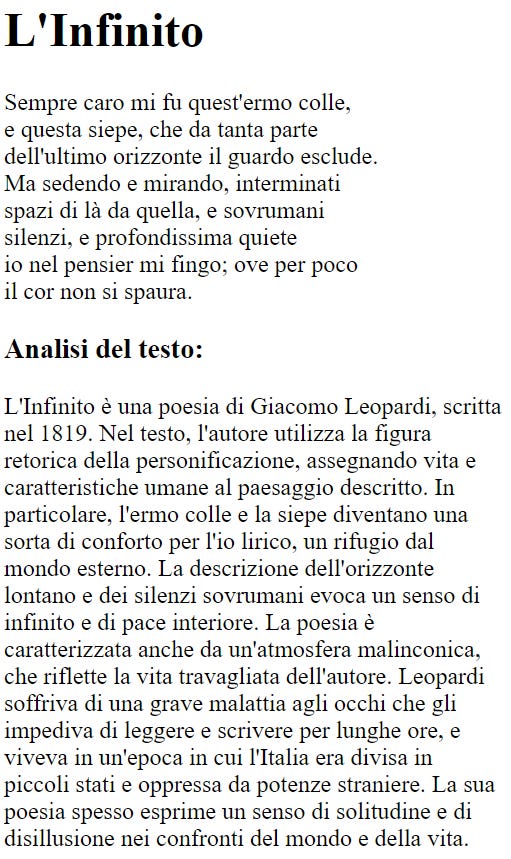
Substack ↗Create an HTML page. Include the original text of Leopardi's L'infinito with a text analysis as if you were a literary critic.
🃏 ff.41.3 Five-player briscola
Substack ↗Write Python code able to recreate the game of Briscola
# Import the required modulesimport random# Define the suits of the cardssuits = ["Spade", "Denari", "Coppe", "Bastoni"]# Define the ranks of the cardsranks = ["Asso", "Due", "Tre", "Quattro", "Cinque", "Sei", "Sette","Fante", "Cavallo", "Re"]
# Define the deck of cards as a list of tuples, where each tuple# contains a rank and a suitdeck = [(rank, suit) for rank in ranks for suit in suits]# Shuffle the deck of cardsrandom. shuffle(deck)
[…]
I'm not including all of it for space reasons, but I tested it and it works!

👩🍳 ff.41.4 Parodi who?
Substack ↗I have in the fridge: pasta, eggs, pork loin fillet, milk, cheese, peppers, beans, apples, cream, lemon, avocado, salami. Can you suggest two recipes, a first course and a main course, starting from what I have?
With the ingredients you have in your fridge, you can make two tasty recipes, for example:
First course: tagliolini with salami and peppers. To make this recipe, start by dicing the salami and peppers, then sauté them in a pan with a little oil. Meanwhile, cook the pasta in plenty of salted water and drain it al dente. Add the pasta to the pan with the salami and peppers and add a little grated cheese. Toss the pasta and serve immediately, piping hot. Main course: lemon pork loin fillet. To make this recipe, start by marinating the pork loin fillet in a bowl with lemon juice, salt, pepper and a little oil for at least 30 minutes. Then heat a non-stick pan and cook the pork loin fillet over medium heat for about 5-6 minutes per side, until nicely browned. Meanwhile, make a lemon sauce by melting a little butter in a small pan and adding the cream and lemon juice. Pour the sauce over the meat and serve hot, with a side of vegetables.

🧬 ff.41.5 Genetic diseases
Substack ↗Write the genetic sequence of a typical hereditary disease and compare it with the original one. Explain how the base variation leads to the alteration of a gene
A typical hereditary disease can be caused by a base variation in the genetic sequence of a gene. For example, cystic fibrosis is a hereditary disease caused by a mutation in the CFTR gene, which codes for a chloride channel. The normal genetic sequence of the CFTR gene is as follows:
ATGACCAGCACCCAGCAGAAGTGGTCTACACACGCCCAGCTAATTTTTGTATTTTTAGTAGAGACTAAGAATGGCCAGGCTA
[…]
Here the output got stuck on the genetic sequence, which is really, really long.
🗿 ff.41.6 Move over, Galileo
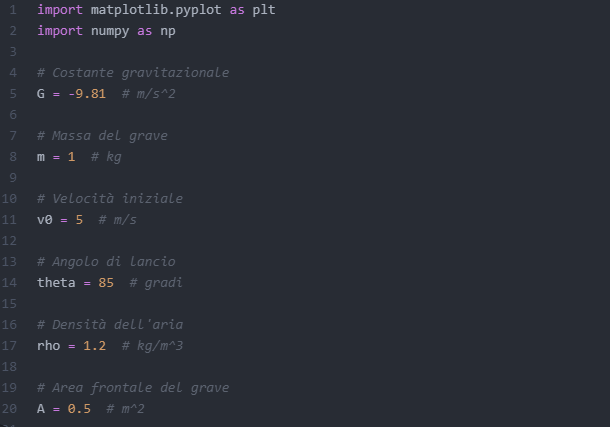
Substack ↗Write Python code to describe a falling body, also taking air drag into account.
Here too, I'm only including part of the output (which comes complete with comments, love it!)
After a couple of tweaks to the code, below is the result, complete with a chart of the object's launch trajectory:
If you change the air resistance coefficient (lowering it), you correctly reach a higher maximum height. So the physics is well represented.
The future has never looked so full of opportunities (and challenges!). What do you think?
Loading...
👋 And that's all for this fortissimo week! 🔜 In the next ff we'll talk about China! See you soon, Michele
Want to support this project? Subscribe to the newsletter and share it with a friend on WhatsApp
👇🔥Subscribe
Or buy me a coffee 😏
☕
And remember to leave a little heart below.
❤️