
Futuro Fortissimo Archive
🎼 ff.42 Made in China (pt.1)
The Silk Road has never been so rough
Published · Michele Merelli
- How much do we depend on it for producing precious materials?
- Where does it stand between pollution and green innovation?
- Taiwan and Pelosi: a new world order?
Themes🏛 Geopolitics, economy and society🌍 Nature, climate and energy🤖 AI, agents and models
⛏️ ff.42.1 Precious minerals?
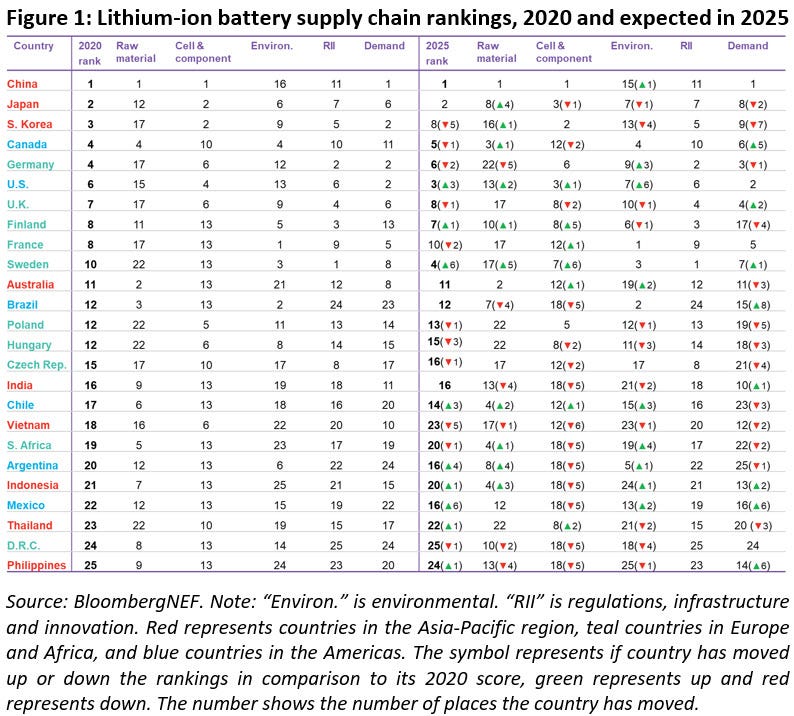
Substack ↗The magic 80%. As with so many distributions (hello again, Pareto), China controls 80% of solar panel production and of lithium extraction/refining. Europe, at least, is improving.
The ranking of electric battery makers (by market share):
🥇 CATL - 35.0 % - 🇨🇳 |🥈 LG - 14.4 % - 🇰🇷 |🥉 BYD - 11.8 % - 🇨🇳 |
Loading...
The interesting thing is that this supremacy isn't so much due to China's mining capacity (as is often thought) as to its “monopoly” on other stages like chemical refining (80% of production) and the final assembly of lithium cells (73% of production).
Some comparisons of installed solar capacity against other demographic and economic parameters (GDP per capita and population):
INSTALLED SOLAR, GDP AND POPULATION |🇨🇳 307 GW - 🇺🇸 95 GW (3x) |🇨🇳 12 k - 🇺🇸 69 k (1/5x) |🇨🇳 1400B - 🇺🇸 332B (4x) |

❓ ff.42.2 Polluting, or pushing the transition?
Substack ↗Until a few years ago, China was synonymous with smog-choked cities. With the data on electric mobility and renewable energy, this bad reputation seems to have improved a little.
Or not? China is still the world's largest CO2 emitter (1/4 of total emissions), and emissions are estimated to peak only in 2030, with net-zero by 2060. It's also still the largest builder (52% of the total) of coal plants, with 91 GW in 2021 (these absolute numbers should always be weighed against the size of the economy and population)
But it has also invested more than any other country in the energy transition ($266B, 2.4x the US):
5x and 17T. Economically, to reach net-zero China needs to invest a total of $17T (so, with $266B, in 2021 it invested 1.5% of the total) and increase current renewable output by a factor of 5x.

🐌 ff.42.3 A spanner in the AI works
Substack ↗Supremacy in electrification suggests an all-Chinese future. But on topics like artificial intelligence the situation is a bit different:
Technological (and military) development is tied to artificial intelligence. Artificial intelligence is strongly tied to the computing power needed to train it. The technical know-how for building graphics cards/compute nodes for training is in US hands (NVIDIA, AMD). In the last year a full-blown embargo on American products began, to slow down China's computing power and technological/AI development.
It's interesting to note that, in the long run, this will have an effect similar to what we're seeing in microchip manufacturing: the United States and Europe are building independent semiconductor factories. China could do the same with AI.
The Taiwan case. In short, every state is trying to be as independent as possible. If the benefits of globalisation were to disappear, trade and interdependence between countries would shrink, raising the risk of tensions and, eventually, wars. What's happening with TSMC (Taiwan Semiconductor Manufacturing Co) should ring an alarm bell ($40B invested in the US by them in the last year)
🌐 ff.42.4 A new global order?
Substack ↗All these reflections raise a question: are we facing a new global order? Ray Dalio (already quoted in 📈 ff.14.2 Nostradamus: Ray Dalio and the world order) thinks so.
Inflation, dollar devaluation and internal unrest in the United States (culminating in the storming of the Capitol last year) are typical of the final phase of an empire.
Oh, and last year saw the release of the Chinese film with the biggest budget to date, in which the good guys (Chinese) hold out against the bad guys (Americans) in the Battle of Lake Changjin, during the Korean War (1950-1953). Propaganda preparing for a fight?
Balaji@balajisJust saw The Battle at Lake Changjin. Through-the-looking-glass experience, where the good guys are the plucky underdog Chinese and the bad guys are the powerful Americans.
It’s the #1 movie in the world, and seemingly meant to prepare for conflict. youtu. beThe Battle at Lake Changjin Official Trailer 39:15 PM ∙ Oct 20, 2021755Likes181Retweets
👋 And that's all for this fortissimo week! 🔜 In the next ff we'll talk about Christmas and snow! See you soon, Michele
Want to support this project? Subscribe to the newsletter and share it with a friend on WhatsApp
👇🔥Subscribe
Or buy me a coffee 😏
☕
And remember to leave a little heart below.
❤️
