Futuro Fortissimo Archive
🎼 ff.88 Singularity in 2029?
The robotic acceleration powered by ChatGPT and FigureAI
Published · Michele Merelli
- Are we in a financial bubble with NVIDIA stock?
- Why will 2029 be the year of the singularity?
- Will robots fix Rome's potholes?
Themes🤖 AI, agents and models
🧩ff.88.1 A financial bubble?
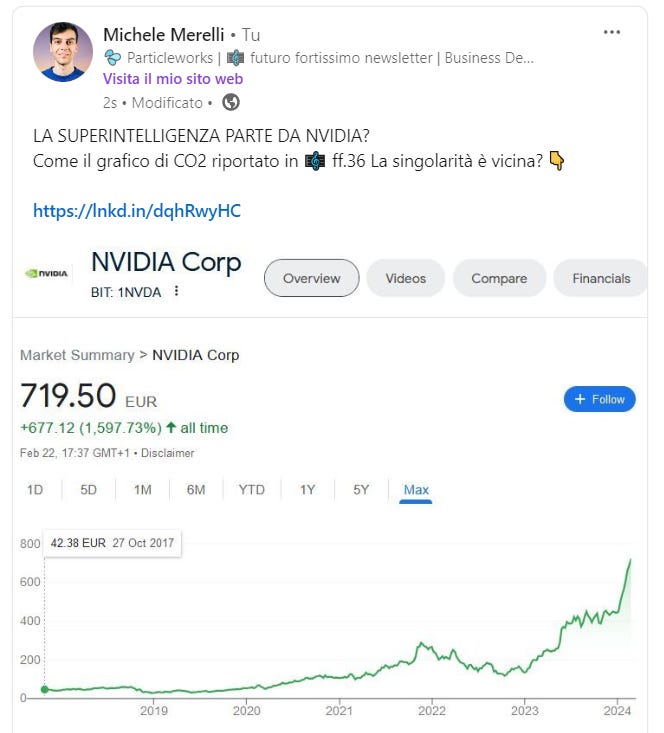
Substack ↗Chickens coming home to roost. Tell me something: has your hairdresser also asked you about investing in NVIDIA? When finance gets discussed this widely, it's usually time to sell. Or is it?
NVIDIA's price seems to have taken off on an exponential trend, like CO2 emissions (🎼 ff.36 Is the singularity near?).
Behind all this, of course, is LLM training, powered by the American company's ever more powerful GPUs. First signs of the singularity?
Is this time different? Maybe yes. NVIDIA has grown impressively over the last three years, tripling its revenue in the last year alone.
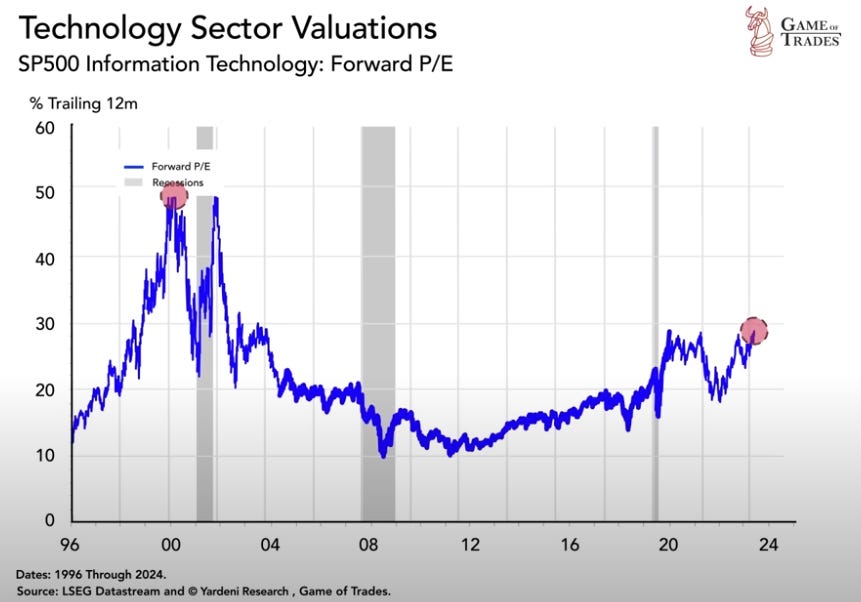
Compared to the dot-com bubble of the 2000s, the tech sector is trading at a 50% discount.
🤖ff.88.2 ChatGPT controls a robot
Substack ↗Why? The market looks to the future and sees it very optimistically. Partly thanks to the FigureAI video below.
What's phenomenal about it:
What you see are not “hard-coded” actions. The spectacular jumps of Boston Dynamics' dogs are finely scripted by programmers; here the robot moves autonomously. The robot learns these movements and links them to goals very quickly. The interface with the robot is voice-based (thanks to OpenAI and GPT)
👀ff.88.3 From words to deeds
Substack ↗Reading reality. Yann LeCun, head of AI at Meta, points out: when reading, a human takes in 12 bytes/s. ChatGPT was trained on 10^13 bytes (5,000 billion words, 100,000 years' worth of days spent reading).
Do I see right? The optic nerve carries 16 million times more data to the brain than we can absorb by reading, so much so that a 4-year-old has seen 50x the data ChatGPT was trained on.
Has ChatGPT opened the road for robots to understand the world visually?
Given how much visual data there is compared to text, there's a whole world still to discover for artificial intelligence. It has only just been conceived.

🔮ff.88.4 The Maya prophecy (or rather, of
Substack ↗Ray Kurzweil, futurist with 21 honorary doctorates, stopped by Joe Rogan. Below, a 15-minute excerpt that's well worth a listen.
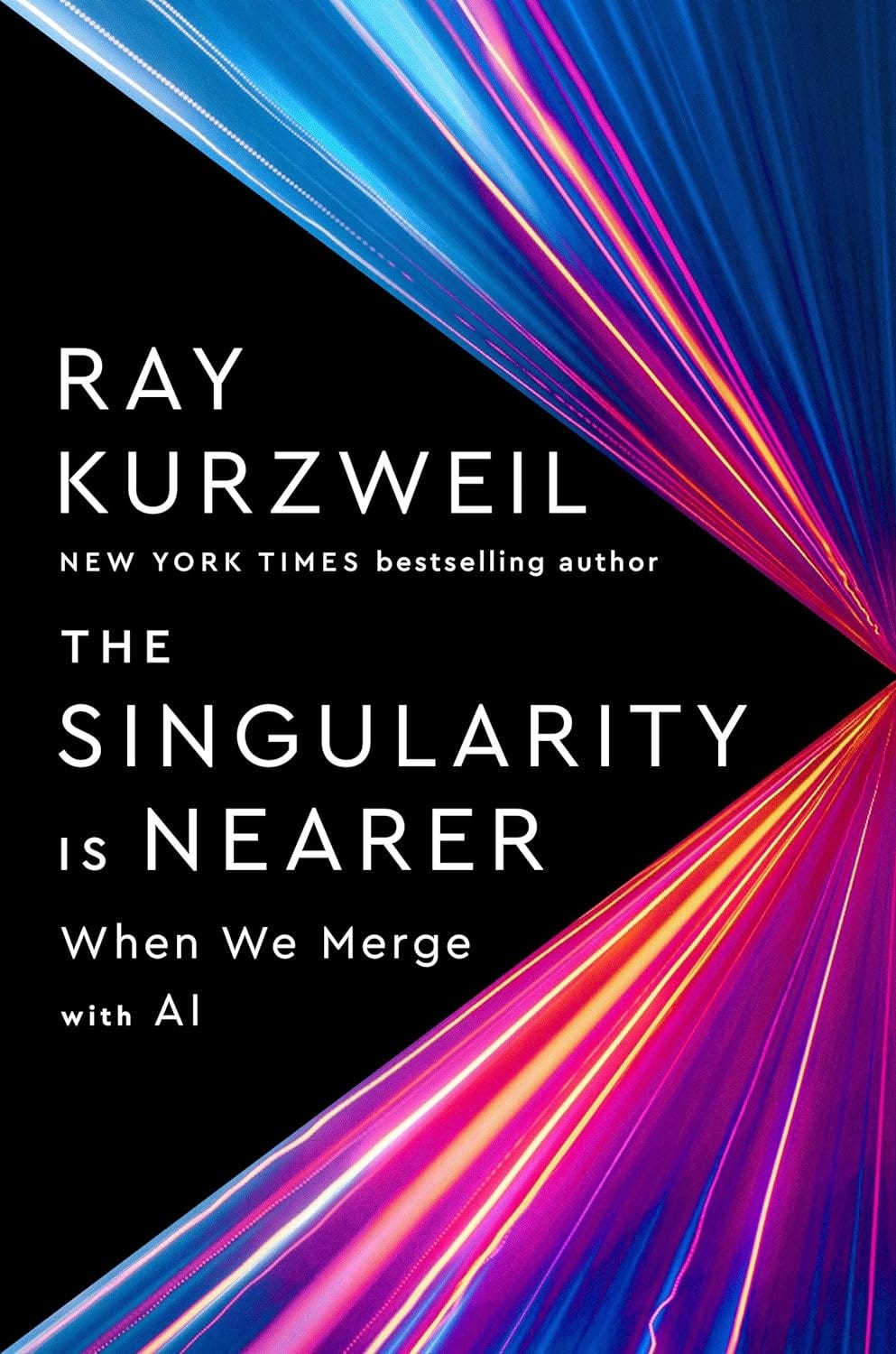
Ever since The Singularity Is Near (2005), Ray has used Moore's law to estimate the advent (no pun intended) of AGI (Artificial General Intelligence). Since 2005 he's put it at 2029. And he recently confirmed the prediction.
Moore in the real world. The difference from the dot-com bubble lies in computing power pouring into physical technologies (one example: solar panels extract 1,000 times more energy than 20 years ago).
Humanoid robots offer far more flexible applications (mines, agriculture, building infrastructure…).
GDP growth will be dizzying. And everything will keep accelerating.
So see you in June for the update: The Singularity Is Nearer.
📈ff.88.5 A couple of examples of acceleration
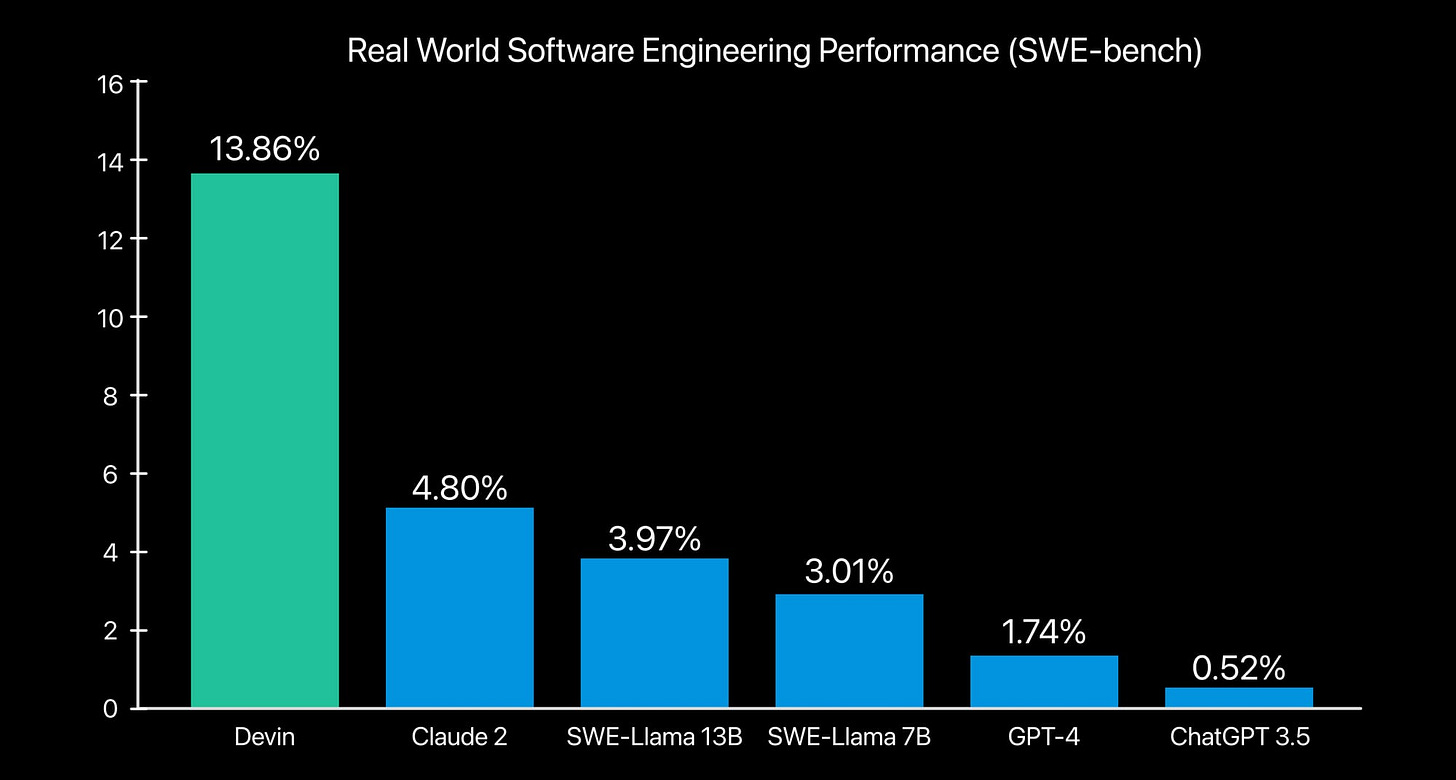
Substack ↗Claude (Anthropic's GPT) was the only one to understand the scientific paper of Kevin Fischer, a PhD in quantum physics. Colleagues and other experts in the field couldn't. Cognition AI, with its team of 10 maths olympiad medallists and a list of heavyweight investors (a $21M Series A from Founders Fund, Peter Thiel's fund), unveiled Devin, the first fully AI software engineer.
1 in 6, 10 times better than GPT-4. That's how often, from an input like “write a program to find potholes in the road”, it manages to produce working code.
Speaking of potholes. Devin earned €500 in a few minutes, solving this request on UpWork.
Is it stealing jobs? That's one possible, pessimistic reading. My fortissimo one: it created €500 for humanity (by solving a task that maybe nobody would have done).
a little heart below? ❤️
🎼 futuro fortissimo is an idea by Michele Merelli