
Futuro Fortissimo Archive
🎼 ff.9 Automation
Will robots steal our jobs, or just the housework?
Published · Michele Merelli
- Are they the reason pay packets have stagnated compared with rising output?
- How many does Amazon employ, compared with human employees?
Themes🤖 AI, agents and models🏛 Geopolitics, economy and society
🧹 ff.9.1 A real-life WALL-E
Substack ↗DeepMind, the English artificial intelligence research lab linked to Google, is always on the ball when it comes to fortissimo stuff.
Roomba who? Below, a video of a virtual robot able to tidy up the house. Watching videos like this, it looks like an animation (and not a very well-made one) of a coat rack.
Actually, what you're seeing is the result of movements the AI learned on its own by studying human experience.
Modelling and creating entities that understand aspects of everyday life is fundamental to having functional robots in every field.
DeepMind@DeepMindIntroducing MIA, a Multimodal Interactive Agent that cooperates and communicates with humans in a 3D virtual world called the Playhouse. MIA trains with imitation & self-supervised learning using 2. 94 years of human experiencedpmd. ai/imitation-lear…dpmd. ai/imitation-lear…1/2:17 PM ∙ Dec 8, 2021681Likes146Retweets
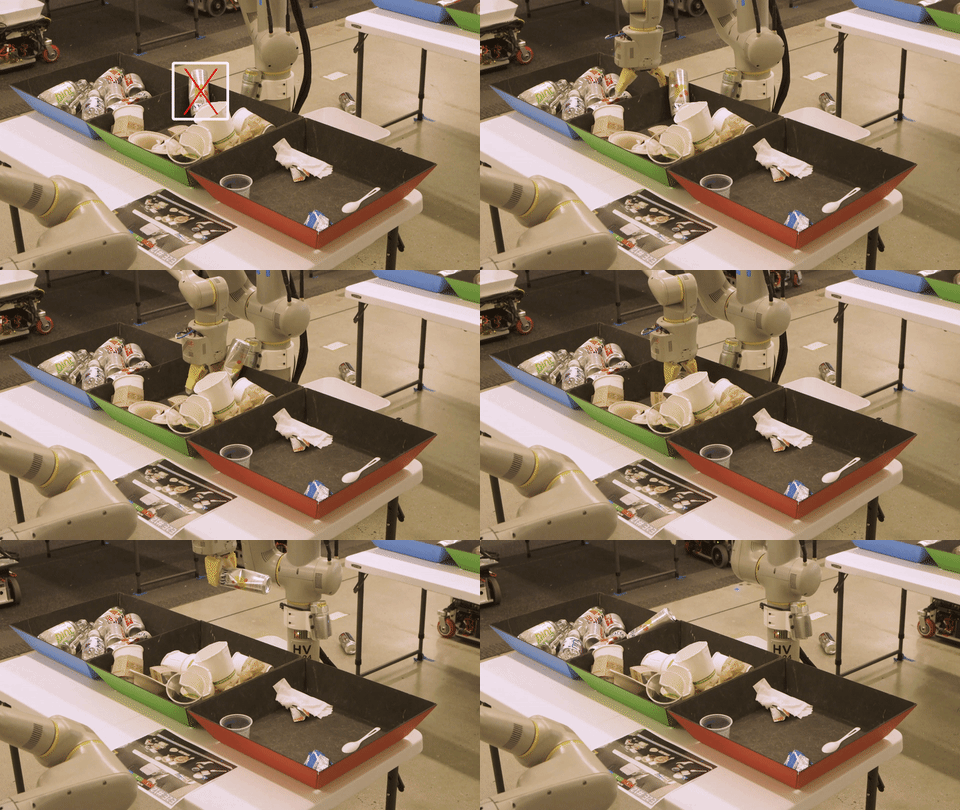
And here's all this applied to real life: for a few months now some of these prototypes have been deployed on the Google campus in San Francisco. There, they help with things like recycling or cleaning.

💱 ff.9.2 Will robots steal our jobs?
Substack ↗A book that analyses automation trends and their impact on society in detail is The rise of the robots by Martin Ford (2015).
The main theses:
Beyond the trend already started in the 20th century, with the automation of physical work, in the 21st century "high-end" jobs will be automated too (think doctors, engineers, translators, lawyers). Because of this, the concentration of value is ever more pronounced. Companies leverage digital tools more than human ones. YouTube had 65 employees in the year it was sold for $2 billion.
The main supporting data (a selection):
To keep up with demographics we'd need to add 100,000 jobs a month; in the first decade of the 2000s, 9 million jobs were "burned". The chart below shows a strong divergence between productivity and compensation (robots, as a rule, don't get a higher wage if they produce more).
By the numbers: in 2021, 29,000 robots were ordered in the United States, an increase of 37% over the previous year.
Amazon automates: it employs 350,000 robots against a human workforce 4 times larger. Over the last 5 years the number of human employees has grown by a factor of 5.6, the number of robots 7.7 times.


👔 ff.9.3 Optimism takes flight (with a basic income)
Substack ↗Actually, it seems that automation itself could help with the wage stagnation we saw above.
In rich words:
Despite projected automation increasing global GDP, the average living global adult in 2050 is left roughly 1% worse off. Only in Japan - with its high share ofhigh skill workers, very old population, and highly redistributivefiscal system - are all skill groups born after 2027 made better offin the baseline scenario relative to no automation.[…]How can nations deal with these challenges? We evaluate two policies - onefor developed nations who adopt the technologies, and onefor less developed regions that do not. Using the US as an example, we show how a universal basic income (UBI),funded with a combination ofdebt-financing and a progressive income tax, can make automation into a win-winfor all skill and age groups.

🦼 ff.9.4 Robots beyond disability
Substack ↗A beautiful solution could be the example of DAWN: a Japanese café with robots as waiters. The twist? These robots are remotely controlled by people with disabilities.
This example reminds us that the economy isn't a zero-sum game. We can create unexpected and unpredictable synergies thanks to robots (as proven by the last search you did to remember the name of that famous actor).
👋 And that's all for this fortissimo week! 🔜 In the next ff we'll talk about the metaverse! See you soon, Michele
Want to support this project? Subscribe to the newsletter and share it with a friend on WhatsApp
👇🔥Subscribe
Or buy me a coffee 😏
☕
And remember to leave a little heart below.
❤️