Futuro Fortissimo Archive
🎼 ff.23 Privatised marriages
Why getting married should be like a gym membership (maybe).
Published · Michele Merelli
- What have the relationship trends of the last century been?
- Should marriage be privatised?
- Do millennials still go to bed (with another person)?
- Why Tinder is more unequal than Venezuela.
Themes📱 Attention, screens and habits🤖 AI, agents and models🏛 Geopolitics, economy and society
🌬️ ff.23.1 Relationships over the last 100 years
Substack ↗This beautiful GIF by Flowing Data sums up, in just a few frames, everything we have to say to each other today.
It shows the % of people, by age, who are single, married or divorced. Each line is the average of a decade, from 1900 to today. The most recent decades are the least transparent ones.
More and more people aren't married (at least until 30) or get divorced (around 50). Basically, shorter and less stable relationships.
At the same time, acceptance of polygamy seems to be on the rise. Over the last 20 years, it has gone from 7% to about 20.
In this context of short and increasingly "flexible" relationships, maybe we need to talk about marriage in more detail.


👰ff.23.2 Privatised marriage?
Substack ↗Even though 50% of marriages end in divorce (at least in the United States), many people believe their own marriage has only a 1% chance of failing.
The lack of clarity of prenuptial vows (the private agreements signed) and the rigid legislation on the various problems that can arise in a marriage shape these trends.
In Nudge: improving decisions about health, wealth and happiness, the authors argue that privatising marriage would improve the situation. Getting married should be an experience similar to joining a sports, political or volunteering association.
People stay tied to their friends, their churches, their coauthors, and their employers for a long time. And even without a government licensing scheme or legal sanction, people take their private commitments seriously. Members of religious organizations, homeowners’ associations, and country clubs all feel bound, sometimes quite strongly, by the structures and rules of such organizations. Recall that if some kind of commitment is desirable, nothing in our proposal prevents people from making commitments through the civil union form or purely through private institutions. With respect to marriage, there are powerful arguments for privatization—for allowing private institutions, religious and otherwise, to do as they wish, subject to default rules and criminal prohibitions. We have argued that states should abolish “marriage” as such and rely on civil unions instead. If religious institutions want to restrict “marriage” to heterosexual couples, they should certainly be permitted to do exactly that. If such institutions want to limit divorce (that is, ending a “marriage”), they could do that too. The beauty of this proposal is that it would allow a wide range of experiments—increasing freedom for individuals and religious organizations alike while at the same time reducing the unnecessary and sometimes ugly intensity of current public debates. Nudge: Improving Decision About Wealth, Health, Happiness(pag. 265-269)
After all, we're so used to social newsfeeds and Netflix recommendations so personalised that the rigidity of certain traditional rituals can feel very tight.

🧹ff.23.3 Nobody's having s*x any more
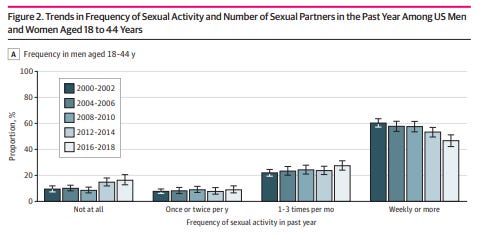
Substack ↗27% of the population under 30 is a virgin. This, apparently, is the figure from a General Social Survey study (via The Washington Post). According to the same survey, one person in three hadn't had sex in the past year (in 2018). With COVID, things hardly got better.
A slightly more scientific publication shows the following trends in the frequency of sexual activity among people aged 18-44. Each column is the two-year average from 200 to 2018.

🔥ff.23.4 Tinder's “wall”
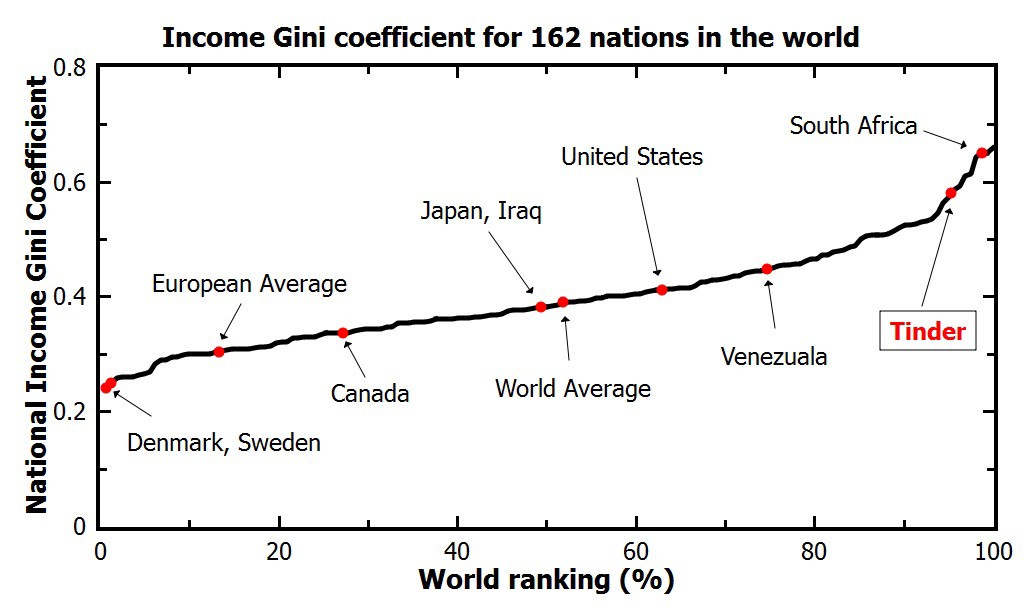
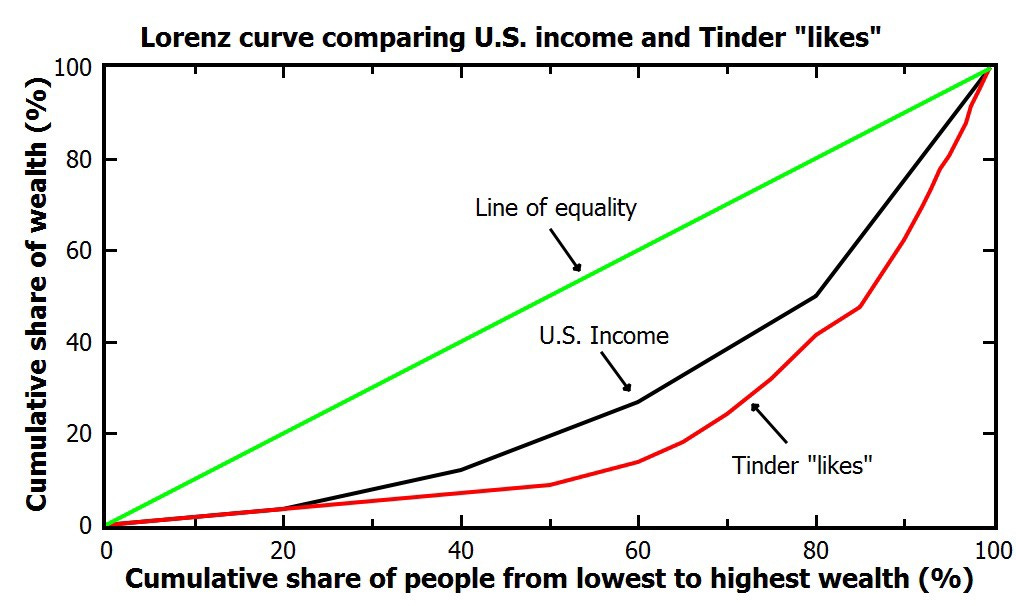
Substack ↗Tinder was supposed to be the solution to being cooped up at home. The problem? It has a Gini index (which measures inequality, traditionally of income) worse than Venezuela's.
The Medium blog Worst-Online-Dater (the name says it all) tackles Tinder likes in a very mathematical and detailed way.
In theory, as "attractiveness" goes up, the chance of scoring on Tinder should rise accordingly. Well, it doesn't. Especially for men.
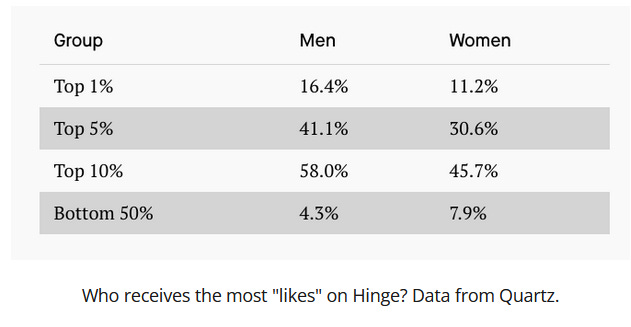
85% of likes go to the top 1% of alpha males, looks-wise (below, the Hinge data, a platform similar to Tinder).
This is an extreme version of the Pareto principle. So Tinder's algorithms don't seem to do much for building stable couples, giving those who have likes even more likes, and those who don't even more frustration.
Impossibly beautiful. If you're of average looks, the chance of getting likes drops to 1%. Good luck with the swipes!
👋 And that's all for this fortissimo week! 🔜 In the next ff we'll talk about cryptocurrencies and war! See you soon, Michele
Want to support this project? Subscribe to the newsletter and share it with a friend on WhatsApp
👇🔥Subscribe
Or buy me a coffee 😏
☕
And remember to leave a little heart below.
❤️