
Futuro Fortissimo Archive
🎼 ff.3 Metaverse
Facebook becomes Meta, but will it manage to build the metaverse?
Published · Michele Merelli
- How Meta (read: Facebook) wants to lead the transition away from “good morning, coffee?!1!” posts
- Pixelated punks that cost more than a Lamborghini.
🏙️ ff.3.1 What are you really, Meta? (part 1)
Substack ↗Facebook, WhatsApp, Instagram and "the whole gang" have been put under the mask of Meta.
Short for metaverse, Meta wants to lead the development of a parallel world made of:
a reality that's not only digital but above all augmented, integrated with the "real" one; web3 (digital ownership); unified profiles; finiteness (my own personal addition).
Let's see where we are in building it:
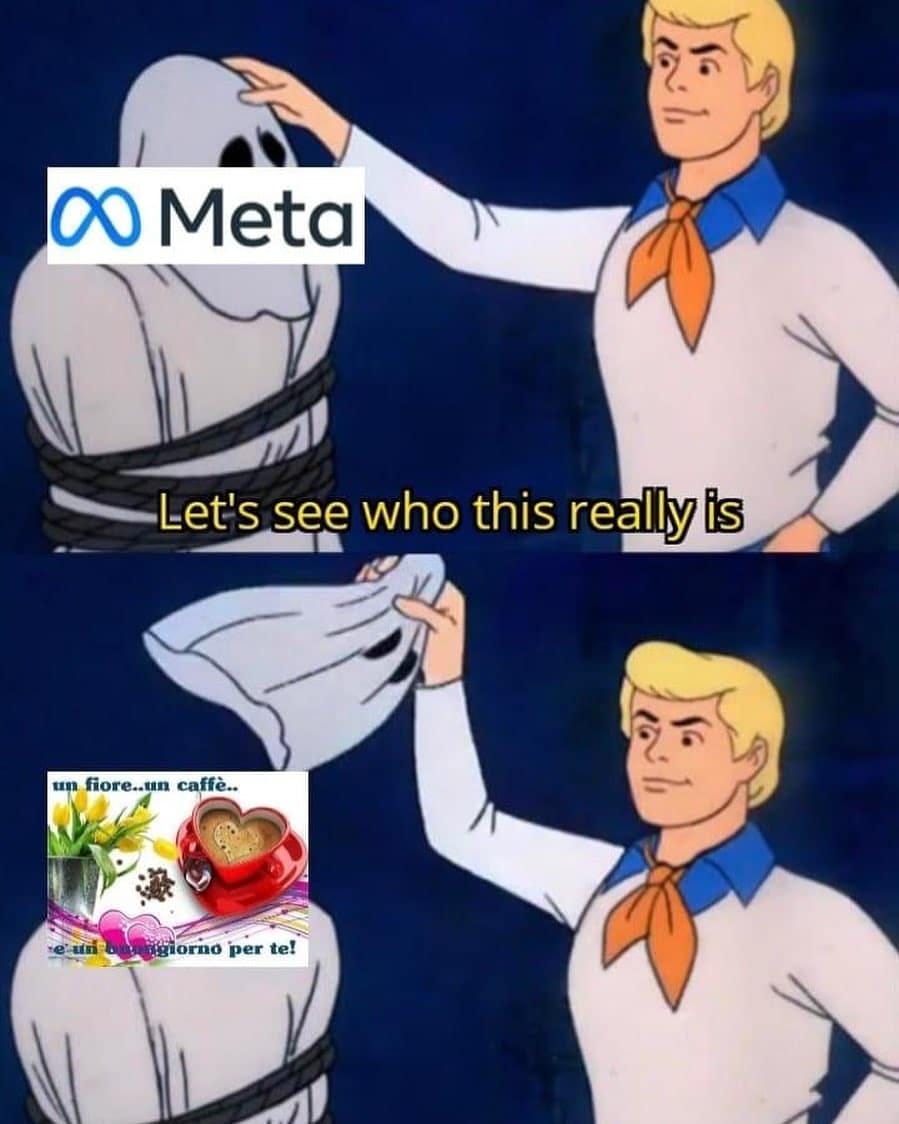
For now, under the mask of Meta and the metaverse there are only the unlikely good-morning messages sent by your favourite aunt.
👽 ff.3.2 What are you really, Meta? (part 2)
Substack ↗In the chat below, Mark Zuckerberg talks about the process that led him to Meta and what he'll try to integrate.
Gary (1.10): What led you to Meta? Mark (2.46): Meta is a way of saying that we don't just work on social media, but on technologies [like Oculus, acquired 7 years ago, ed.] to create contacts, groups, relationships. And to improve them. Gary (4.30): Oculus! You've been working on it for 7 years. Feels like yesterday. But at the same time it took a long time to digest that acquisition. Mark (6.40): Digital communication started with SMS, then images (after cameras were built into phones), now it goes through video. But that's not the end point. Holograms could be the next step within five years. Gary (7.20): Do you think it could happen in just 3-5 years? I saw you fencing against the world champion, projected Obi-Wan Kenobi style. Mark (8.40). Augmented reality is different from virtual reality. Virtual reality is already here, for example with Oculus Quest. But augmented reality needs a lot of engineering and work on size. Gary (10:00): Can we shrink headsets down to a contact lens? Mark (10:30): I don't know, you still need to power it and connect it to the internet. For now, the technology isn't there. Gary (11:00): 5 years ago there was PokemonGo. Since then, though, there haven't been other large-scale examples of augmented reality. What do you think? Mark (11:12): PokemonGo is more about location; I don't think it's really augmented reality. Instagram filters are more of an example in this direction. A necessary aspect on the way to augmented reality is touch: augmented reality is, for example, feeling a friend's digital "high five". We're investing 10 billion a year in these devices.
Gary (17:00): Can you give me a sense of the WhatsApp and Instagram acquisitions? Mark (11:12): It's amazing to see how ways of communicating have evolved. We were the first to create the newsfeed. But honestly, we didn't develop every possible way of communicating. Hence the acquisitions. Gary (19:13): The newsfeed! When it was introduced and you could no longer just log into Facebook and post on your contacts' "wall", loads of people protested. But now every social network is built around the newsfeed. And what about web3?
Mark (24:00): Web3 and NFTs (non-fungible tokens) are an important element of the metaverse. Each user will be a unique reality, with their own digital objects (tokens) and cross-platform connections, not compartmentalised in isolated apps as happens now. To be continued…
👺 ff.3.4 All façade?
Substack ↗Some argue that, despite Meta's visibility and reach, there are systems much closer to the metaverse than those offered by Mark's suite.
For example, Discord.
👾 ff.3.5 Discord
Substack ↗What Discord is: Discord was born as a calling server to guarantee clean conversations, without lag or robotic voices. Adopted first in the gaming world, today it has a range of uses, with servers devoted to finance, learning and cryptocurrencies.
What makes it different: the ability to share music and videos, to watch a film together. Also, a bit like Clubhouse, some Discord channels are invite-only. That's why many NFT-related groups (see ff.3.7 for details) are building their identity around this technology: they create digital lounges accessible only with certain carefully verified prerequisites.
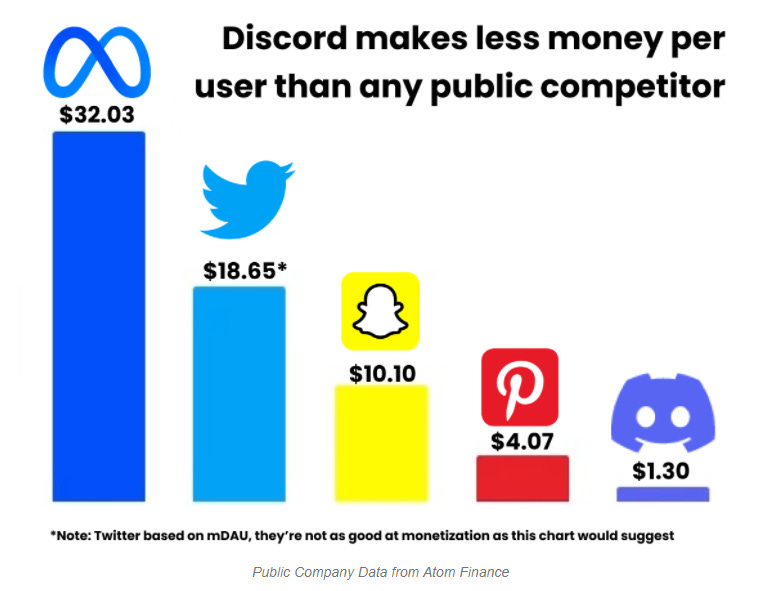
Discord is still in its early days, though, as its monetisation shows:
But its growth over the last two years is truly astounding. If you want to dig deeper:
🦾 ff.3.6 Body–computer integration
Substack ↗As Mark said in the previous interview, getting to the metaverse takes a lot of new technologies, like brain-computer interfaces.
A Nature publication shows how to convert the thoughts of a paralysed patient into text, all of it:
fast (90 characters per minute) [when you're in good shape you hit 125 with your big thumbs]; accurate (95% confidence in the translation).
The patient was asked to imagine writing certain characters by hand. Below, the movements and the associated letters.

💸 ff.3.7 Tokens that cost as much as a Lamborghini
Substack ↗NF… what? NFTs are digital units owned uniquely and validated with the blockchain. This newsletter is already too long for a detailed explanation. We'll come back to it.
For now, just know that some people pay from 200 thousand to well over several million to own the artwork below.
Or rather, to be (at least digitally) a CryptoPunk and get access to the exclusive circle that comes with it. And, of course, to be at the frontier of a technology that will change everything again: the metaverse.
👋 And that's all for this fortissimo week! 🔜 Next week we'll talk about how to bring a mammoth back to life. See you soon, Michele
Want to support this project? Subscribe to the newsletter and share it with a friend on WhatsApp
👇🔥Subscribe
Or buy me a coffee 😏
☕
And remember to leave a little heart below.
❤️
