
Futuro Fortissimo Archive
🎼 ff.82 A war fought with chips
Will GPUs be the trenches of the 21st century?
Published · Michele Merelli
- A cold war fought in nanometres
- How much do AI models pollute?
- Do we spend more on computers than on people?
Themes🤖 AI, agents and models🏛 Geopolitics, economy and society
🦖ff.82.1 Mass extinction?
Substack ↗500 million years ago, the Cambrian explosion. Perhaps a new organism able to produce oxygen “suffocated” the other life forms that lived by breathing CO2.
Today, CO2 is scary again. AI-driven emissions are growing: one exchange with ChatGPT equals an hour of LED light, one DALL-E image a smartphone charge.
Will computronium be the next form of life? Will CO2 get its revenge?
But, but, but. Doom and sensationalism aside, here on 🎼ff let's try to dig a little deeper into the question:
Comparing ChatGPT to LED light is misleading. In one case we're talking about the first example of a mass technology, in the other the result of a century of improvements (compared to the tungsten filament). Even if ChatGPT uses 10x a Google search, how many other Google searches does it prevent?
What's more, MIT points out that AI's energy consumption can bring benefits and that efficiency solutions already exist:
rolling out Small Nuclear Reactors (Microsoft's proposal), optimised management of computing resources
Nerd corner. The report on projections of internet energy consumption.


🐔 ff.82.2 Computational chickens
Substack ↗My cock is much bigger than yoursMy cock can walk right through the doorSystem of a Down,Cigaro
With this analogy, System of a Down tackle the arms race. Data centres could be the next “cock”, the next rockets, the next trenches.
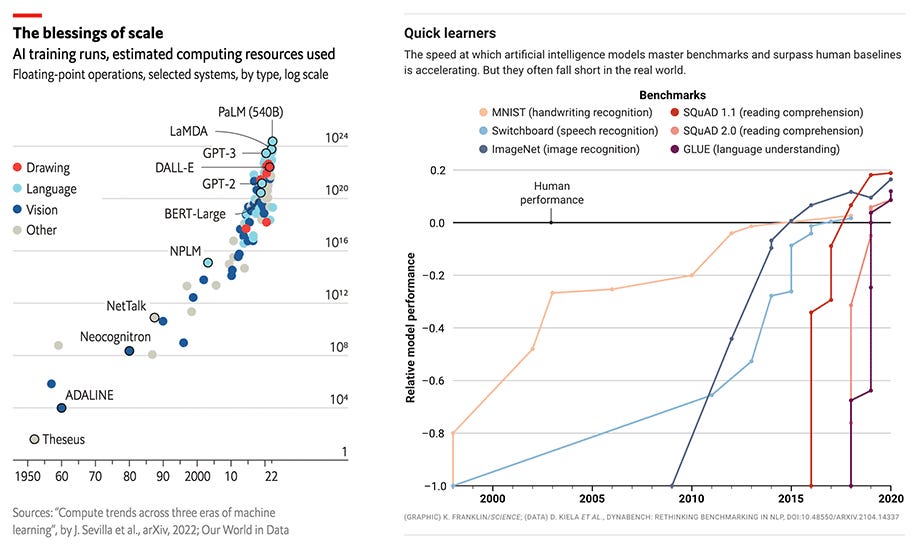
True, smaller and more efficient models are spreading (see Mistral, the French startup that scares OpenAI), with results comparable to the Goliaths GPT-4 and Gemini. But as parameters (and computing power) scale up, results keep getting better.
Good. It's not a given to have a technology that improves simply by throwing more resources at it: see the “S-curve” innovation of wind turbines and combustion engines.
🥶ff.82.3 Cold war
Substack ↗Back to the chickens: what's happening on the political front? The embargo on chips and ASML lithography machines to China has been in place for a while (🐌 ff.42.3 A spanner in the AI works). Chris Miller digs deeper in Chip War.

🥵 ff.82.4 Hot war
Substack ↗In 2024 NVIDIA will produce 1M H100 GPUs ($40k each, with 9x the performance of the A100).
Noam Shazeer, CEO of Character.ai, calculates that we have enough GPUs to run one GPT-4 model per person. But there isn't computronium for everyone, and the war is above all between companies.
Tesla grabbed only 15k GPUs. Even OpenAI (despite the Microsoft partnership) doesn't have all the resources it needs (maybe one of the reasons behind Altman's ousting, later reversed?).
Visionary as ever, Musk is building his independence with Dojo, the tailor-made supercomputer that in 2024 will be in the world's top 5 (analysis by Sawyer Merritt).
David among the Gol-AI-ths (sorry). Columbia researcher Ishan Dhanani wants to democratise access to computronium by decentralising it.
before you go, remember to leave a little heart below. ❤️
past issues | instagram | linkedin | a coffee


