
Futuro Fortissimo Archive
🎼 ff.34 Rethinking cities
What COVID and climate change taught us about cities
Published · Michele Merelli
- But are we really living more and more in cities?
- Will artificial intelligence teach us to make them more liveable?
- Cities: space consecrated to the car.
Themes🌍 Nature, climate and energy🤖 AI, agents and models🏛 Geopolitics, economy and society
🏙 ff.34.1 Ever more city dwellers
Substack ↗It's a fact: we increasingly live in urbanised, “non-rural” areas, which many nations define as settlements of 2,000-10,000 people. As a percentage of the population:
🇮🇹 70 % | 🇺🇸 80 % | 🌐 55 %
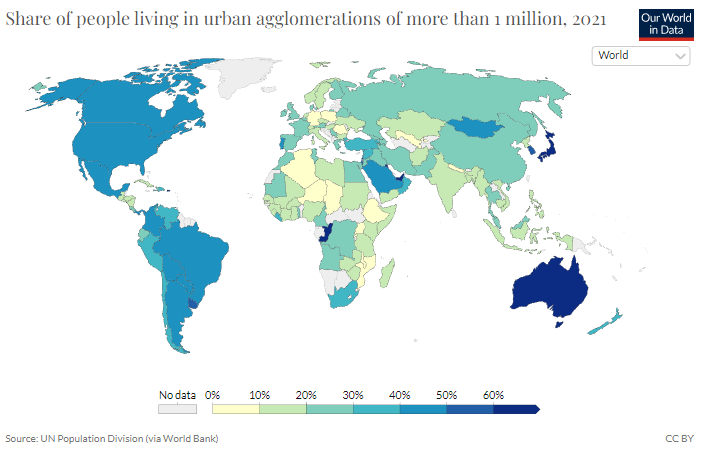
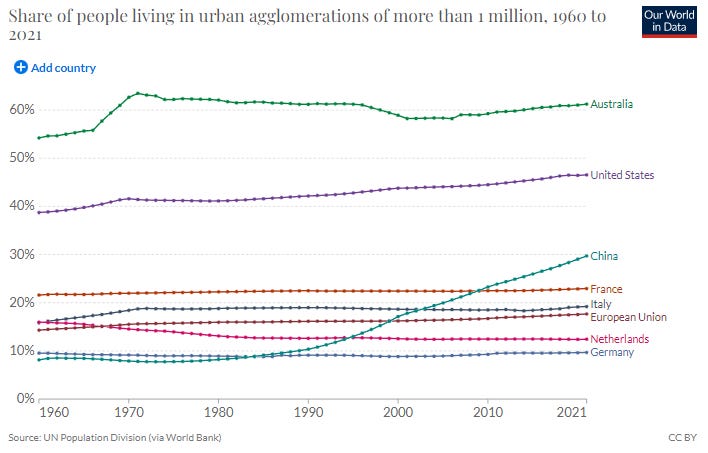
Who wants to be a millionaire. For me, “living in a city” means a much bigger settlement. Let's say a million people. If we take that number as the definition of urban areas, the percentages change:
As you can see, the share of “true city dwellers” is relatively stable worldwide (except for China). In Europe it's below 20%. In Australia and the United States, 60% and 40% respectively.
🚦 ff.34.2 Rethinking cities: mobility and traffic
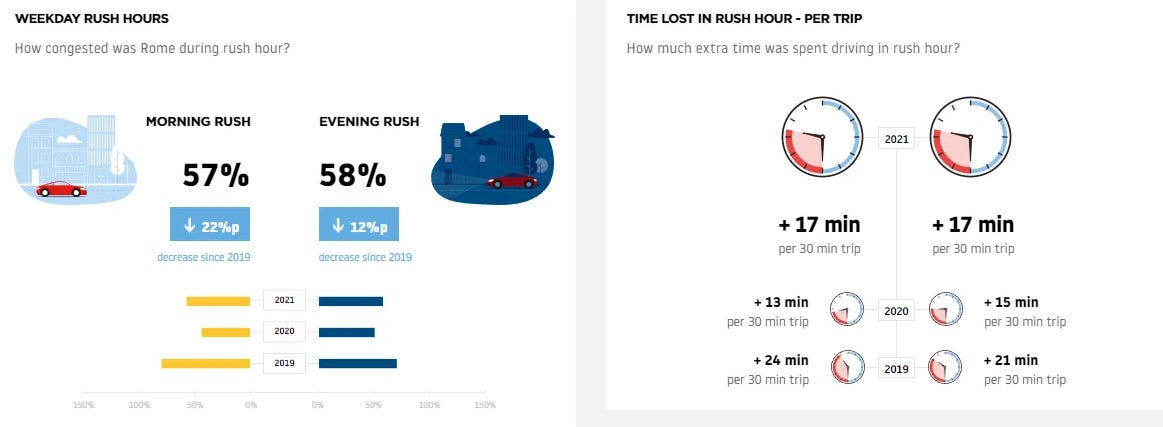
Substack ↗Even if most Italians live outside settlements of 1M people, they often travel to these nerve centres for work during the day. And we know it well, given the amount of traffic (especially between Pero and Cormano). COVID and remote working have improved things a bit. But how much?
TomTom (does anyone still use it?) does an interesting analysis and has loads of data broken down by country and city. Below, a snapshot of Rome.
After the return to “post”-COVID normality, Rome's traffic is below 2019 levels. From 24 minutes of delay (in the morning, 21 in the evening) it went to “just” 17 minutes in 2021.
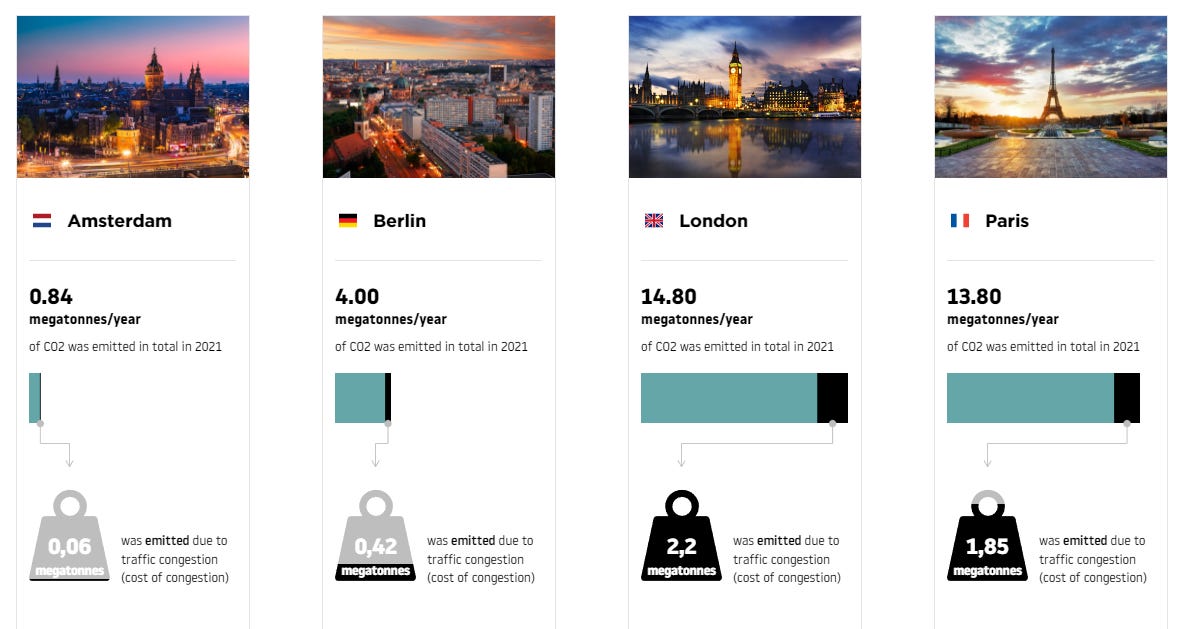
10% of pollution from queues alone. The site estimates the amount of CO2 due to congestion. In Paris, for example, of the 13.8 MT of CO2 a year linked to mobility, more than 10% could be avoided without queues (maybe with flexible working hours or remote working?). In Am(mi)sterdam emissions are 10 times lower, because everyone cycles.
🚦 ff.34.3 Rethinking cities: liveable spaces
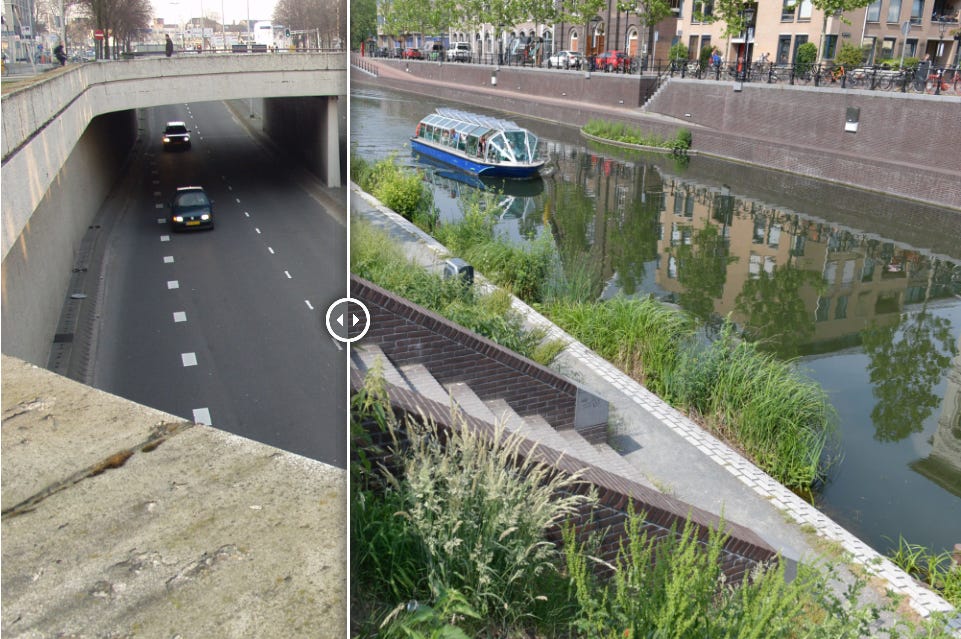
Substack ↗Speaking of Amsterdam and the Netherlands. In the '70s the Dutch were staunch supporters of cars and turned 900-year-old canals into roads.
U-turn. Then a series of projects strongly discouraged car use and gave space back to greenery and canals. This before-and-after gives an idea of how the city has been transformed again and made more liveable.
Then there are those who ask Artificial Intelligence to do the same using street images from Google Street View. AI opens up new visions that, in our concrete-covered habits, we can't conceive.
AI-generated street transformations@betterstreetsaiHindley Street (Adelaide, Australia)6:00 PM ∙ Aug 8, 2022136Likes7Retweets
🥵 ff.34.4 Rethinking cities: heat
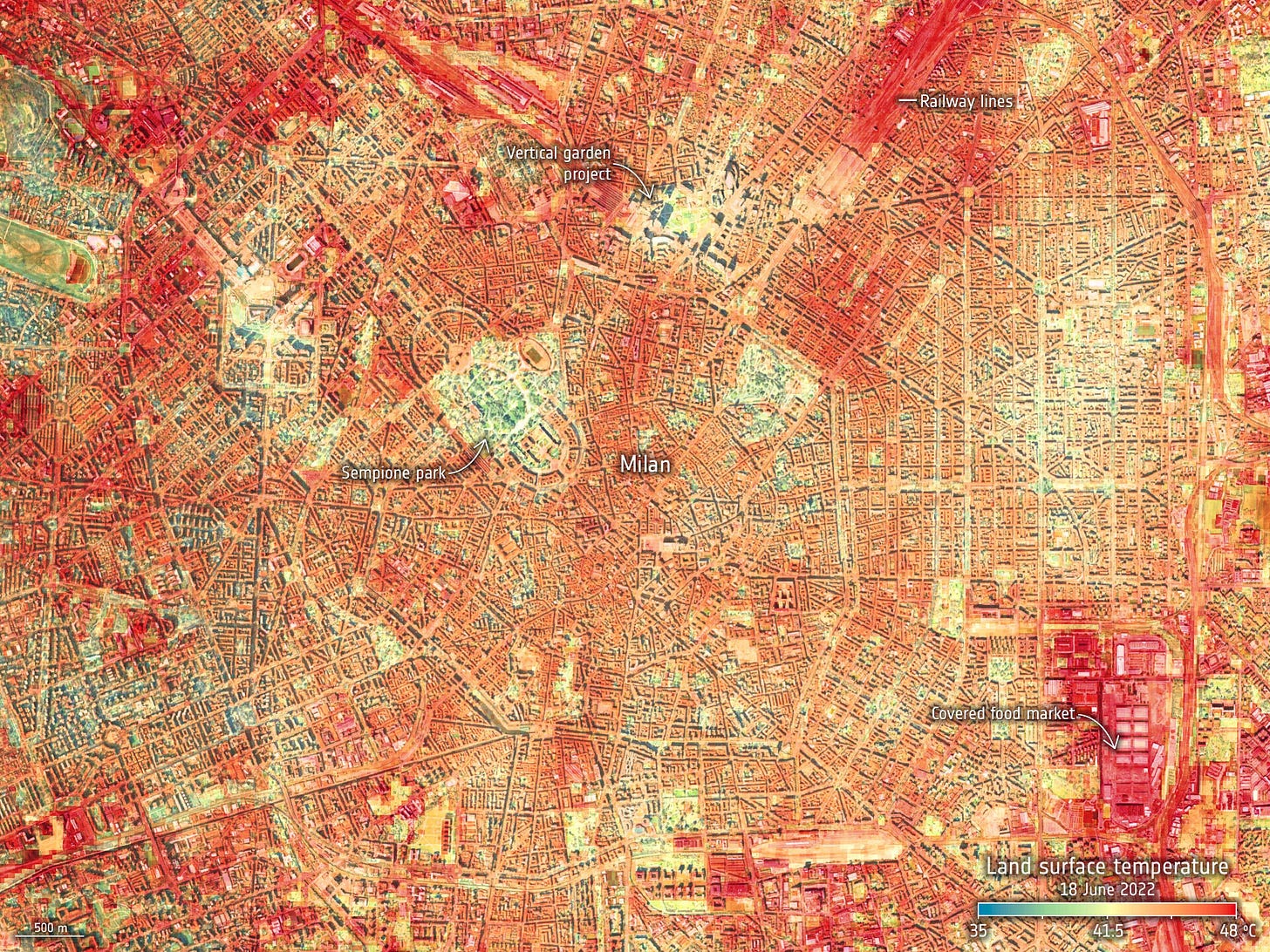
Substack ↗With last summer's heatwaves (don't you miss it a bit, apart from the Jova Beach Party?), we realised it's better not to hold the Ferragosto barbecue in the city.
The European Space Agency (ESA) collects infrared images showing ground temperatures in a handful of European cities. It's fascinating to see 10-degree gaps between green areas (like Parco Sempione) and railway stations or covered markets (Milan's Fruit and Vegetable Market, presumably a shed with lots of air conditioners).
1️ ff.34.5 It's all a monoculture
Substack ↗Finally, let's get philosophical, fortissimo, right?
Homogenising space for cars. Journalist Thalia Verkade and urban planner Marco te Brömmelstroet argue in the Guardian that cities are yet another example of monoculture and homogenisation.
Just as we now grow very few plant varieties (with the resulting problems of pest epidemics wiping out harvests), we devote loads of urban space to a single factor: mobility. Roads (rather than spaces for relaxation, sport, culture and socialising) fill every corner of the city.
In rich words, as they write:
… just as swathes of our countryside were repurposed for farming, over the past century our city streets have been optimised for one goal: to move people around as quickly as possible, unhindered by anyone using public space for other purposes. This has its benefits — who wouldn’t argue that it is useful to be able to get from one side of a city to another quickly and efficiently — but they have come at a cost. Our shared urban environment, which used to be for everyone, is by and large dominated by moving and parked cars.
Cars infect every corner of our cities. And yet there's never enough parking, though there's always enough traffic. Who'll find the solution? Tesla with Autopilot or some micromobility startup?
👋 And that's all for this fortissimo week! 🔜 In the next ff we'll talk about how we're Super Sapiens! See you soon, Michele
Want to support this project? Subscribe to the newsletter and share it with a friend on WhatsApp
👇🔥Subscribe
Or buy me a coffee 😏
☕
And remember to leave a little heart below.
❤️