
Futuro Fortissimo Archive
🎼 ff.33 Will plants save us?
An ode to plants, between algorithms, CO2 capture and problems to solve
Published · Michele Merelli
- Plants: from photosynthesis to a source of knowledge
- Silicone leaves for greater efficiency
- How to tweak genetics to capture more CO2
Themes📱 Attention, screens and habits🌍 Nature, climate and energy
🧠 ff.33.1 The philosophical and cognitive value of trees
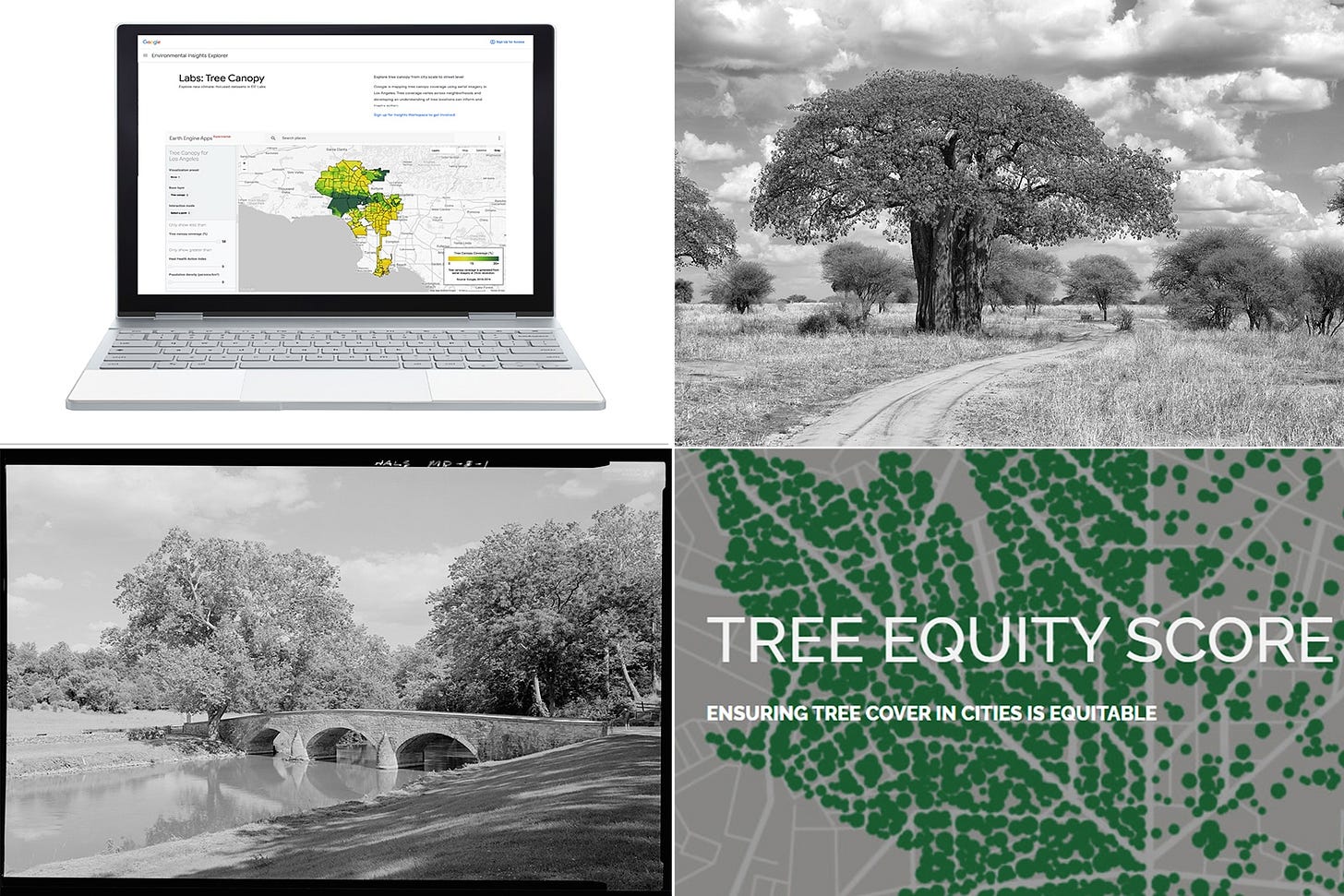
Substack ↗The connection between humans and plants has historically been very close. The tree has always been at the heart of many cultural aspects: from Adam and Eve to medieval theories of knowledge, all the way to search and optimisation algorithms (like the decision tree). Plant branchings have inspired and helped humans to define themselves, to understand the world and themselves.
Shannon Mattern, an anthropology professor at The New School for Social Research in New York, traced the history of this relationship in the short essay Tree Thinking.
🍁 ff.33.2 CO2 collectors
Substack ↗Plants, besides capturing CO2 during photosynthesis, keep it locked up for a shorter or longer period (in the carbon of bark and leaves). A Science study by the University of Zurich calculated that we could plant 0.9 million hectares, with a potential storage of 200 Gt (gigatonnes) of carbon (each year we emit about 30). When a tree dies, though, part of the captured CO2 is released back into the environment as it decays.
Peat-what? And yet peatland (see the image below to get a rough idea of what I mean) is much more efficient at holding CO2.
Here are the Gt of carbon “held” in:
Forests | 8% of land | 272 ± 23 Gt of carbon; Peatlands |2% of land| 415 ± 150 Gt of carbon
If you want to dig deeper, here's a great newsletter:
Climate Tech VC🌎 Peaty blinders: in bog we trust #101Happy Monday! Outside of great potential for puns, peat also contains more than 3x the carbon as forests on a hectare basis. Despite it taking longer to form, its stewardship and carbon removal capacity is at odds with its’ use as a cheap fuel alternative. Innovation in its preservation is burgeoning, though its carbon credits markets are still relative…Read more4 years ago · 12 likes · 1 comment · Sophie Purdom and Kim Zou
Two more interesting ideas on this:
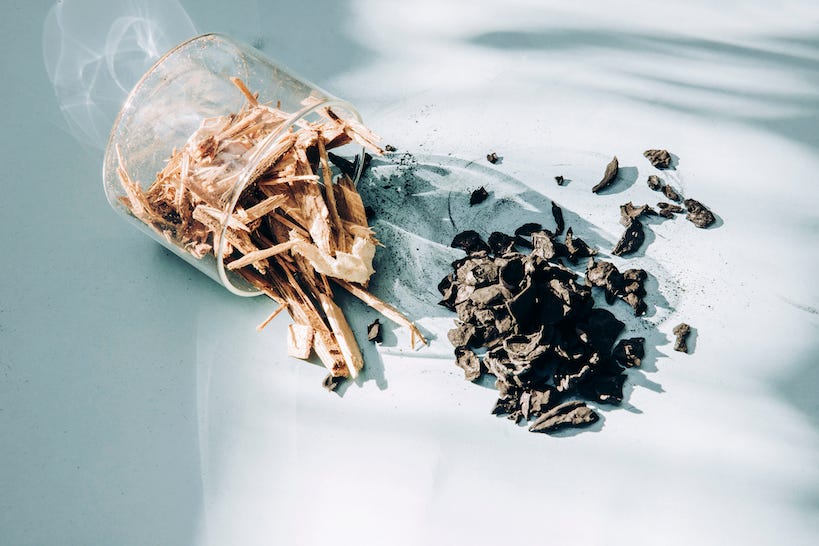
Dendra uses a mix of drones, AI and satellite analysis to optimise efficiency and biodiversity when planting. Carbo Culture is working on creating biochar able to stabilise captured CO2 and keep it from escaping through rotting.

🏭 ff.33.3 Plants modified to capture CO2
Substack ↗Plants are lazybones. Plants don't go all out to capture CO2. For example, even when there's plenty of sun, they slow their metabolism so as not to run out of other nutrients like water. So the conversion efficiency from CO2 to organic matter, which is then “held” as in the figures above, is low.
Some researchers are using innovative genetic techniques (read CRISPR) to increase the conversion of CO2 into stabilised carbon. Mark Zuckerberg (and his wife Chan) recently funded the Innovative Genomics Institute. This California institute, founded by CRISPR pioneer Jennifer Doudna (Nobel Prize in Chemistry 2020), is where much of the research on CRISPR applications is happening (we'll come back to it in more detail in an ff).
🧮 ff.33.4 Computational moulds
Substack ↗To close the circle between knowledge, algorithms and plants, let's talk about Plasmodium. It's a mould that has been used to find the shortest path connecting various regions (solving the famous Traveling Salesman Problem and showing great computational parallelisation skills).
Transport networks are ubiquitous in both social and biological systems. Robust network performance involves a complex trade-off involving cost, transport efficiency, and fault tolerance. Biological networks have been honed by many cycles of evolutionary selection pressure and are likely to yield reasonable solutions to such combinatorial optimization problems. We show that the slime mold Physarum polycephalum forms networks with comparable efficiency, fault tolerance, and cost to those of real-world infrastructure networks—in this case, the Tokyo rail system. The core mechanisms needed for adaptive network formation can be captured in a biologically inspired mathematical model that may be useful to guide network construction in other domains
In plain words. The researchers placed food to represent the cities to be connected and light gradients (which repel the mould) to define obstacles and topological barriers. In this way, a mould recreated the Tokyo rail map, and did so while showing control over transport speed and other parameters that define the main links. In short, a system like this can be used to calculate and design stable networks given certain operating conditions/limits set by the researchers. As if it were a computer, but it's a mould that simply wants to survive as best it can.
👋 And that's all for this fortissimo week! 🔜 In the next ff we'll talk about how to rethink cities. See you soon, Michele
Want to support this project? Subscribe to the newsletter and share it with a friend on WhatsApp
👇🔥Subscribe
Or buy me a coffee 😏
☕
And remember to leave a little heart below.
❤️
