
Futuro Fortissimo Archive
🎼 ff.46 Elemental, Watson?
Rethinking nuclear for a future we've been waiting for for 60 years
Published · Michele Merelli
- Is fusion the breakthrough of the century?
- The unjustified fear of splitting the atom
- Why “old” nuclear is still necessary
🆕 ff.46.1 Nuclear: a much-needed rebrand
Substack ↗The news of the first net-positive nuclear fusion reactor is a real bombshell. Maybe bombshell isn't the best word.
But, but, but… For 70 years we've already had a solution for producing energy at very low risk and with zero emissions: “traditional nuclear”, fission.
These super-powerful technologies (like gene editing) are complex, multifaceted and potentially subversive. All society needs is one symbolic case (like the (?) Fukushima disaster, or chimerical descriptions of glowing fruit and vegetables) to brand an entire field of research and hold back its development.
The Washington Post: an overview of the real costs/risks of nuclear.
Quoting Josh Wolfe (American investor and co-founder of Lux Capital), the article argues for a nuclear rebrand: elemental energy.
Josh Wolfe@wolfejoshElemental Energy (formerly known as NUCLEAR)—takes holdBill Gurley@bgurleyGreat to see intelligent people from both political parties acknowledge the critical role nuclear energy can play in solving climate change. We cannot get there without it. 🙌🏽🙏 https://t. co/mz0ySb2dJD4:04 AM ∙ May 25, 202299Likes5Retweets
Maybe, though, public opinion is making a U-turn on nuclear.



🚀 ff.46.2 Astronomical costs
Substack ↗Fear has blocked funding, research, deployment and cost reduction. Here's the energy mix (split into emoji) for the US in 2021:
US ENERGY MIX | 61% fossil fuels | 19% nuclear | 9% wind | 3% solar
Even though the United States has a good share, nuclear energy has effectively been stagnant since the '80s:
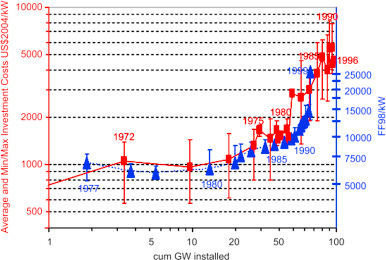
Moore's law's close cousin (actually a generalisation of it) is named after aerospace engineer Wright: Wright's law (1936). It says that the more we produce something, the better we get at making it, and so the faster and cheaper we become.
The cost of regulation. Well, for nuclear this doesn't seem to work. The cost of nuclear energy has grown (an effect entirely linked to regulation). Before 1980 the cost was $1175/kW. At an inflation rate of 2-3%, today it could cost a few cents per kW. Instead we're above $5000.
Nerd corner. The cost of producing one TJ (but also the energy of a heartbeat or of the Cretaceous meteorite)
$/TJ | diesel 26k | natural gas 12k | coal 7k | uranium 20 (no k!)
Winter is coming. Meanwhile, China will build 150 plants over the next 7 years (60% of global growth) and overtake the US as the country with the largest nuclear system. In Europe, on the other hand, apart from France, the picture is sad. Germany, for example, is closing many plants, and only a crisis like the war in Ukraine led to some measures being postponed.
We can't depend on socio-health/geopolitical upheavals (see COVID → remote working) to make the future happen!
Here's a breakdown with numbers on production around the world.
🇺🇸 91.5GW | 🇫🇷 61.3GW | 🇨🇳 50.8GW | 🇯🇵 31.7GW | 🇷🇺 29.6GW


😭 ff.46.3 Wasted years
Substack ↗If nuclear had replaced coal and gas, we'd have avoided 9.5 million deaths and 174 Gt of CO2 (that is, if the 1960-1976 acceleration had continued).
Social and regulatory resistance has led to an embarrassing delay in nuclear research: while quantum mechanics and the Standard Model describe the behaviour of electrons and subatomic particles superbly, our understanding of the interaction between atoms still has big gaps (despite the field's venerable age of 80 years).
We should already have nuclear batteries. And guess what? Your iPhone wouldn't need charging and your Tesla would have a range of 2 million km. Storrs Hall, Where is my flying car? A memoir of future past
In conclusion. Recent developments in fusion are exciting (but it'll take time). Meanwhile, why not appreciate the potential of what we already have? The uranium dissolved in the oceans is enough to supply 10 kW (US per capita consumption) to 10 billion people for 10,000 years (and current technology is close to extracting uranium from seawater economically).
Can we go back to believing in the future? Can we drop the mindset of mandatory cuts, degrowth and sacrifice?
👋 And that's all for this fortissimo week! 🔜 In the next 🎼ff we'll talk about tech news from CES! See you soon, micmer
Want to support this project? Subscribe to the newsletter and share it with a friend on WhatsApp
👇🔥Subscribe
Or buy me a coffee 😏
☕
And remember to leave a little heart below.
❤️