Futuro Fortissimo Archive
🎼 ff.50 WTF happened in 1971?
The great stagnation between gold, bitcoin, iPhones and a rosier future
Published · Michele Merelli
- The annus horribilis: 1971
- What ties together gold, hope in the future and Bitcoin?
- Why do we have unlimited data but homes heated drop by drop?
Themes🏛 Geopolitics, economy and society🪙 Crypto and metaverse🤖 AI, agents and models
🤔 ff.50.1 The oddness of the last 50 years
Substack ↗In 2011 Tyler Cowen, an economics professor at George Mason University, published the famous book The Great Stagnation, arguing that the last 50 years have seen techno-economic stagnation. Then there's a website, WTF happened in 1971, that collects charts thrown off kilter since that year. I'll pick three at random.
Inflation looks out of control (here the last 300 years):
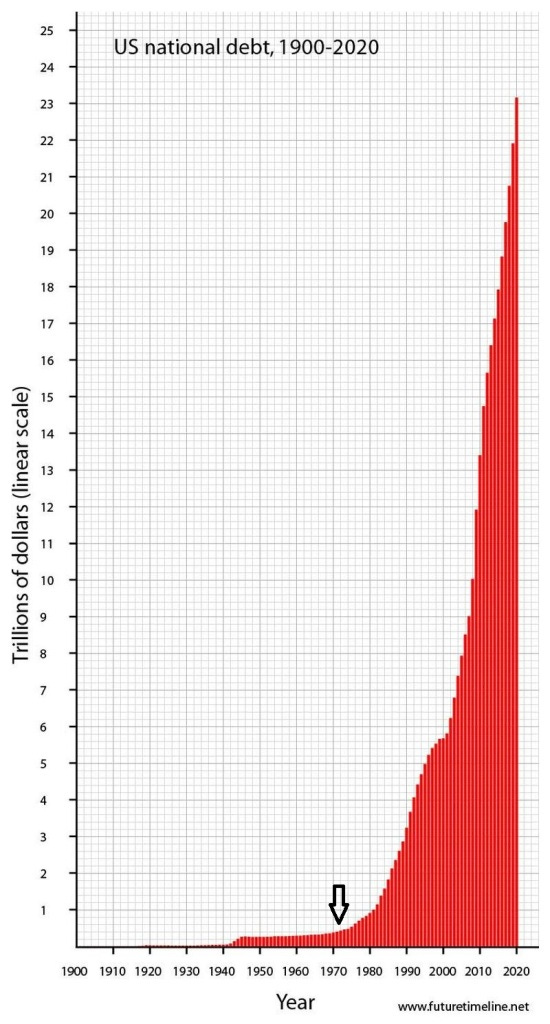
US public debt has exploded to today's $32T ($94k per citizen or $234k per taxpayer):
And house prices have followed the same trend (here Amsterdam):
But, but, but. The last 50 years have been very, very peculiar. Economic boom, spread of education, population explosion, the digital world and the chip revolution. And, more recently, the pandemic and lockdowns, the subprime crisis and the “.com” one.
Too many issues to find a single explanation. But let's look at one possible contributing cause: monetary policy. Money printed whenever needed.



🪙 ff.50.2 Gold, silver, myrrh, beer and Bitcoin
Substack ↗The golden age. Columbia economist Saifedean Ammous, in The Bitcoin Standard, points out that the technological progress of the 20th century (symbolised by the belle époque) coincided with the implementation of the gold standard, the monetary system that guaranteed the conversion of each country's currency at a precise rate.
Below, the value of various currencies against gold, with a clear plateau between 1920 and 1970. Then, a sharp, massive devaluation.
A future that devalues. OECD data, after all, show that from 1990 to 2015 the global annual increase in currency was 7.2%. Here's the situation in the US.
currency devaluation → less faith in the future → less investment → less growth → stagnation
To restore faith in the future, Ammous proposes Bitcoin as the new standard. Its decentralisation and intrinsically limited supply (21 million) would ensure that nobody manipulates the reserves, stabilising the value of all currencies.

💻 ff.50.3 Technological stagnation
Substack ↗It's not that there's been no progress in the last 50 years. Quite the opposite. Here we try to be optimistic and positive first and foremost. But technological stagnation in some sectors is undeniable.
The strange case of Dr Eroom and Mr Moore. The cost of developing drugs doubles every year (due to the big pharma monopoly or to the regulation demanded by a society more frightened than attracted by a technology).
We landed on the Moon in 1969 and only today, after Musk came up with re-landing rockets to slash costs, are we dreaming of it again.
Despite the many PhDs (which, however, aren't growing the way they did before the '70s), “basic” scientific progress has stalled (in the early 1900s quantum mechanics and relativity; today we've been stuck at the standard model and string theory for decades).
Vaclav Smil, in Growth: From Microorganisms to Megacities, collects many logistic charts showing the saturation of efficiencies in many mechanical systems (mostly invented in the early 1900s and still not replaced by new developments).
In short, in plain words:
We wanted flying cars, instead we got 140 characters. Peter Thiel, co-founder of PayPal and Palantir.
But is it fair to compare different paths of technological development? Again according to Thiel:
Today the word technology means information technology, while in 1960 it meant space travel and nuclear. It's hard to say whether it's better to have an ever snappier smartphone (or one that takes photos a million times better) rather than a flying car.
futuro_fortissimo_newsletterA post shared by VeI2ax (@futuro_fortissimo_newsletter)
My take:
The space/nuclear technology argument is a bit misleading. During the Cold War (or World War II) the acceleration and deregulation were so strong that some technologies arrived “early”. Moore's Law (Wright's law applied to chips) is the most famous precisely because chips were the first example of scalability and a positive loop between process and result (better computers → better chips). Given how easy it was to reap the fruits of Moore's Law (and the considerable benefits involved), the money was invested there. Today, PC performance gains are ever smaller (an example of diminishing marginal utility?) and computing power is fuelling positive loops in other fields (genetics, robotics, AI).

🌟 ff.50.4 Consumers, but not of energy
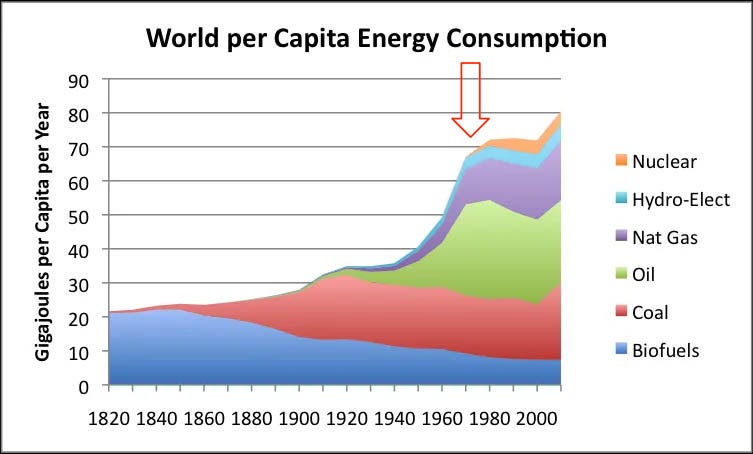
Substack ↗Another sign of stagnation is energy use. Per capita energy consumption (I stress “per capita” given the population explosion of the last century and a half):
Possible explanations:
Dematerialisation and digitalisation; Greater efficiency; Remote working; Limits imposed by the cost of energy
Unlimited gigs. Points 1-3 show we're using energy ever more efficiently. But a major bottleneck on energy consumption is its price.
Especially after the recent events in Ukraine, petrol pump prices and ENEL bills have changed Italians' habits. Energy is not yet as accessible as computing power or GBs of internet data.
🎵 Final notes
Does it make sense that, in 2023, we still have to heat our homes sparingly, drop by drop?
In the next 🎼 ff we'll talk about nature! 👋 See you soon, from micmer
Want to support this project? Subscribe to the newsletter and share it with a friend on WhatsApp
👇🔥Subscribe
Or buy me a coffee 😏
☕
And remember to leave a little heart below.
❤️